


YOSHIROTTEN EXHIBITION: TRANSMISSIONS WITH THE BEYOND / BEYOND EARTH
HAPPENINGText: Alma Reyes
Best known for a surreal and psychedelic artistic approach that merges digital technology with natural elements, Yoshirotten delves into the “visualization of the invisible,” navigating the boundaries between music, fashion, subcultures, art, and commercial design. His two major immersive projects — “FUTURE NATURE” (2018), a group of massive installations integrating 3D works, video, and graphic art, and “SUN” (2023), a series exploring the sun’s projection through 365 digital images — have established the innovative creator as one of Japan’s most prominent contemporary multidisciplinary visionaries today.
Yoshirotten began his early career by cultivating collage-like techniques in portraits and symbols for subcultures. Through extensive research into color, cultures, the Earth, and its celestial bodies, he has embedded science-fiction expressions into his dynamic worldview. He has held solo exhibitions at the Ginza Graphic Gallery, the Kirishima Open-Air Museum in Kagoshima Prefecture, and overseas in London, Berlin, New York, and Shanghai.
Tokyo Node Gallery is presenting “YOSHIROTTEN Exhibition: Transmissions with the Beyond / BEYOND EARTH” until January 11, 2027. Spanning a vast 1,500 square-meter gallery space with a maximum ceiling height of 15 meters, the showcase focuses on two central themes: BEYOND — a distant realm or time inaccessible on foot; and TRANSMISSION — remote communication via signals such as light, sound, or radio waves. The enormous installations convert data from space, the Earth, and cities into images, videos, and light. Viewers are caught in a web of natural light, monitors, and neon tubes that illuminate a diverse collection of paintings, videos, and sculptures. The entire exhibition space, designed as a single spacecraft, encourages them to experience virtual contact with distant, unknown realms through light, sound, and digital art.
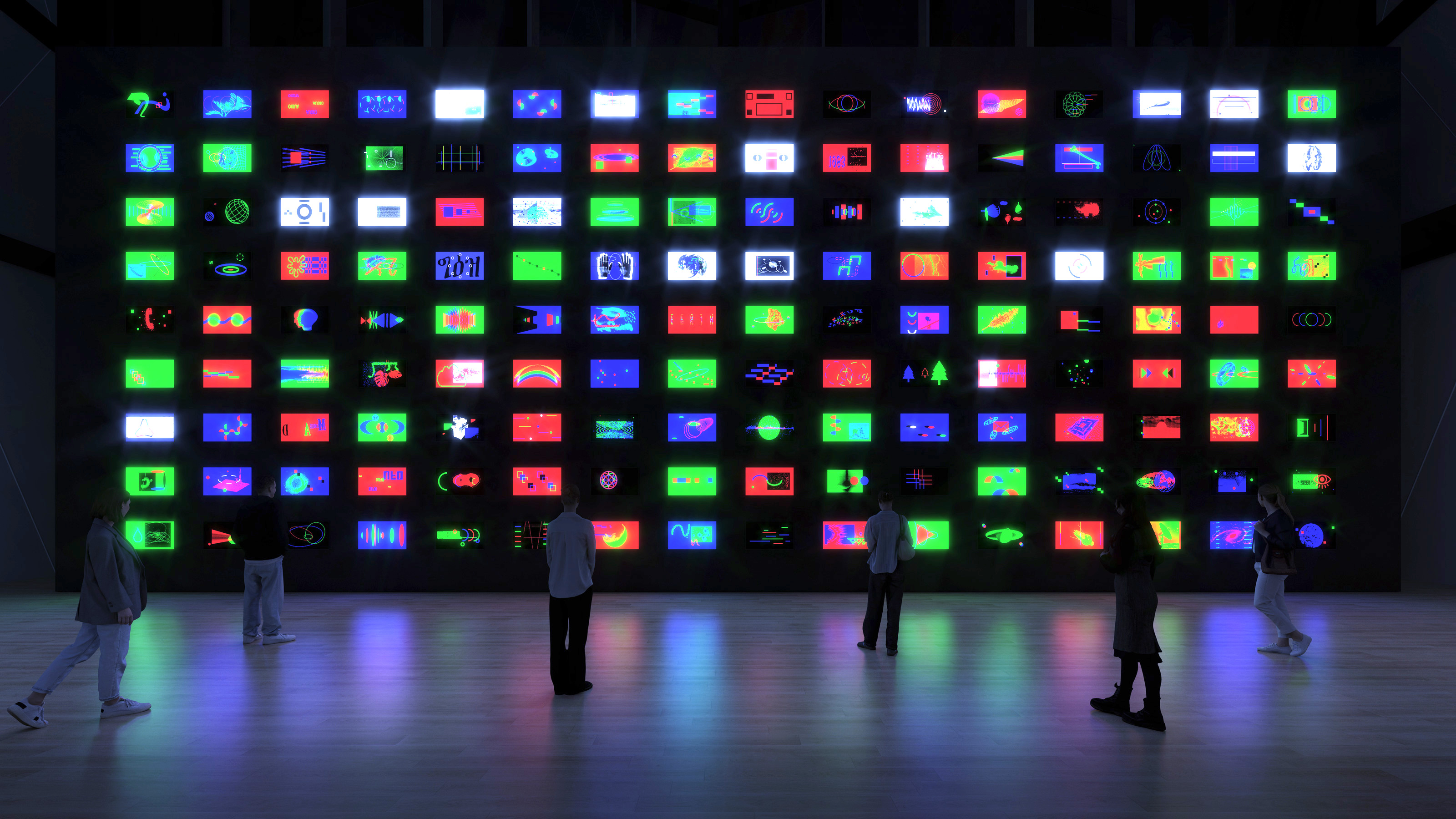
Yoshirotten, Signal RGB, Yoshirotten Exhibition: Transmissions with the Beyond / BEYOND EARTH plan simulation image
In the first gallery, Yoshirotten displays 144 monitors playing moving screensavers, reflecting his childhood memories of staring at his computer screen glowing in the dark. “Signal RGB” combines a myriad of geometric shapes, geoglyph images, plants, text, and natural phenomena that emit red, green, and blue light. Floating in the dim atmosphere, these elements form infinite emerging connections with one another.
The main hall, “FUTURE NATURE,” ushers visitors into a sprawling landscape of space artworks that examine the natural world through technology and imagination. Produced with the cooperation of the Japan Aerospace Exploration Agency (JAXA) — following extensive dialogues with Hiroyuki Yamaguchi, professor at the JAXA Institute of Space and Astronautical Science (ISAS) and principal researcher for the XRISM X-ray Imaging and Spectroscopy Mission — the exhibits draw inspiration from astronomical observation data and research findings.
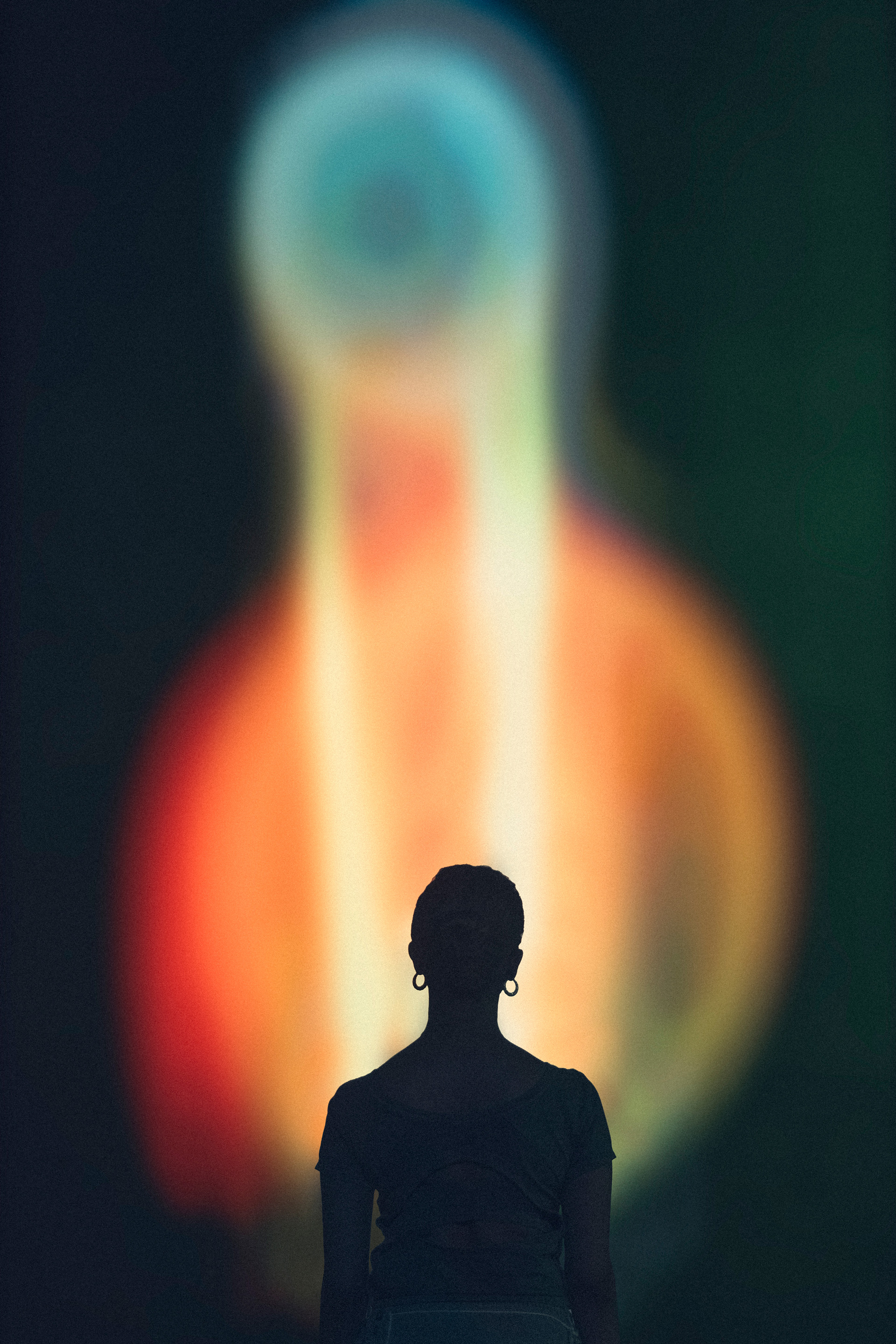
YYoshirotten, Supernova, Yoshirotten Exhibition: Transmissions with the Beyond / BEYOND EARTH concept visual
In this gallery, two giant panels of “Supernova” (gigantic explosions caused by a star’s death) capture stars moving together and apart toward destruction. The symbiotic process revolves around galactic dust of atmospheric colors. Yoshirotten describes it as “a dance where the steps are not decided in advance, or the meeting and parting of two people somewhere.” One can survey the overlapping hues swimming across the background for hours as they metamorphose into multiple shapes.
Installed on a wall, three paintings and moving-images titled “Puddle—Cygnus X-1” convert X-rays around Cygnus X-1, observed by the X-ray Imaging and Spectroscopy Mission (XRISM) satellite, into drips resembling raindrops or ripples on a virtual water surface. Through this digital processing, Yoshirotten makes it possible for humans to perceive a black hole.
“Pyrite,” an intriguing box-like artwork, rotates with a metallic gleam. Named after the lustrous mineral that forms cubic crystals, its position next to the window wall allows viewers to gaze into magical reflections that alter with every angle and distance.
In “Light Pulse,” all-sky observation data procured from the International Space Station (ISS) is transformed into dynamic light and sound in four colors. Cosmic activity hovers above the entire gallery space so that visitors can walk through shifting backdrops of different color gradations and acoustic frequencies.
Read more ...
 1 2