


RON MUECK
HAPPENINGText: Alma Reyes
A dynamic sculptor who captures audiences with provocative and ambiguous pieces, from miniature to life-size, Ron Mueck remains as one of the world’s most intriguing contemporary artists today. His bewildering sculptures elicit a deep scrutiny into humanity and its sea of entangled emotions — loneliness, fragility, anxiety, tolerance, and confusion.
Running until September 23, Mori Art Museum showcases “Ron Mueck,” the artist’s first major solo retrospective in Japan after eighteen years. Co-produced with Fondation Cartier pour l’art contemporain (Paris), the exhibition has traveled from Paris in 2023, to Milan, Seoul, and currently to Tokyo. It features eleven stunning works that summarize Mueck’s progressive career from the mid-1990s to the present.
Raised by a mother who created dolls and puppets, Mueck was evidently influenced in early inclinations toward model making. Mueck started as a creative director of Australian children’s TV shows in the late 1970s to early 1980s. After moving to the U.S., he collaborated as a puppeteer and model maker with the famous Jim Henson for several films and TV programs, honing his admirable skills in sculpting with silicone and fiberglass. Gradually, Mueck gained public attention, particularly through his participation in the “Sensation: Young British Artists from the Saatchi Collection” exhibition at the Royal Academy of Arts in London in 1997. At the show, his staggering portrayal of his own deceased father in “Dead Dad” (1996-1997), imbued with utmost poignancy and sensitivity, left a potent impact on viewers and artists alike.
From his position as Associate Artist at the National Gallery in London from 2000 to 2002, to successive shows at Fondation Cartier pour l’art contemporain, São Paulo, Vienna, Finland, and across the world, Mueck’s intense sculptures have resonated physically, mentally, and emotionally with the audience. He uplifts the vulnerable mortal soul with emphatic facial expressions, poses, and gestures, rich in realism. The figures are neither glamorous nor quintessential, but rather guileless, genuinely rendering the true shades of human characteristics — wrinkles, pores, fat, blemishes, and physical imperfections. They inject powerful magnetism to probe deeper into the fundamental essence of our human existence.
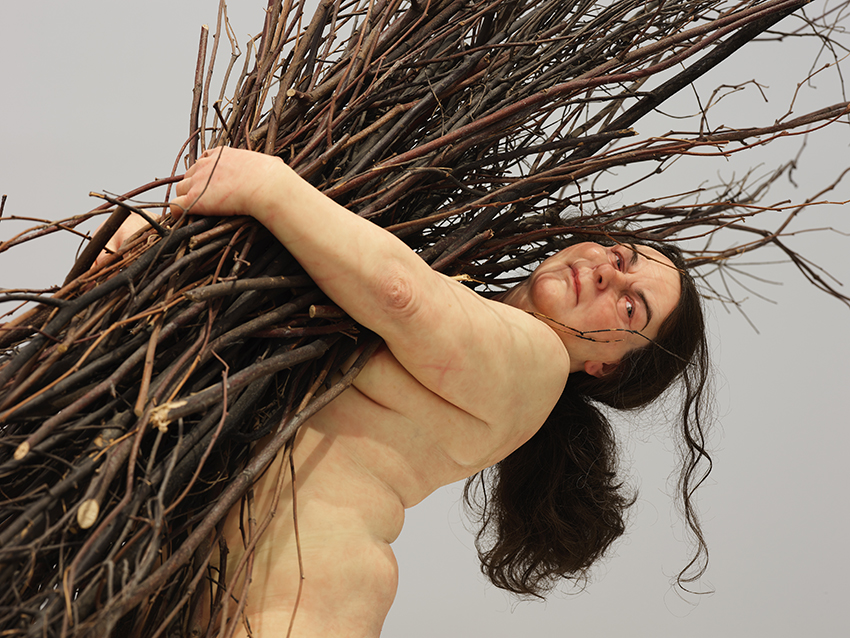
Ron Mueck, Woman with Sticks, 2009, Collection: Fondation Cartier pour l’art contemporain, Installation view: Ron Mueck, National Museum of Modern and Contemporary Art, Seoul, 2025, Photo: Nam Kiyong, Photo courtesy: Fondation Cartier pour l’art contemporain, National Museum of Modern and Contemporary Art, Korea
The first installation on view, “Woman with Sticks” (2009), makes its Japan debut. The naked woman bends backward, struggling to contain the muddled bundle of sticks in her arms. While she appears sturdy and determined, her skin reveals scars and scratches from the exhausting labor. The weight of the bunch of long twigs juxtaposed with the woman’s defenseless build makes viewers feel her hardship and state of helplessness.
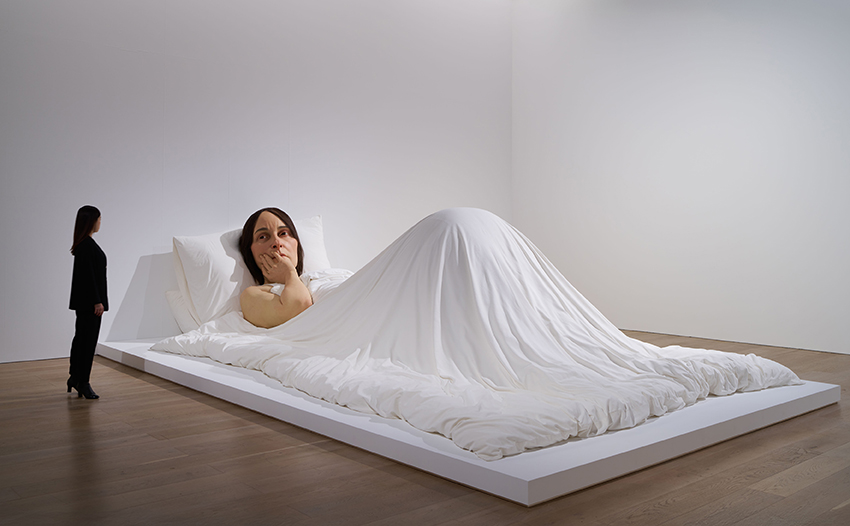
Ron Mueck, In Bed, 2005, Collection: Fondation Cartier pour l’art contemporain, Installation view: Ron Mueck, Mori Art Museum, Tokyo, 2026 Photo: Masaya Yoshimura, Photo courtesy: Fondation Cartier pour l’art contemporain
One of the most captivating works, the enormous “In Bed” (2005), measuring an astounding scale of 6.5 meters long, depicts a middle-aged woman lying comfortably in bed with her knees raised. Her position appears nothing out of the ordinary, yet her distant, penetrating gaze and one hand supporting her chin invite unyielding curiosity: What can she be thinking of? Could she be lonely, unhappy, or afraid? The curves and every detail of her skin lines and folds, knuckles, nails, and facial contours are astonishingly realistic.
Read more ...