


LUCAS MUSEUM OF NARRATIVE ART
PLACEText: Victor Moreno
Opened just a few weeks ago on September 22 in Los Angeles’s Exposition Park, the long-anticipated Lucas Museum of Narrative Art is a home for the images that taught us how to dream. For most of the last century, magazine covers, comic panels, pulp paperbacks and film posters were filed under entertainment, not art. George Lucas has spent five decades quietly arguing otherwise, buying the evidence piece by piece. Now he has won the argument by going public: Norman Rockwell next to Robert Crumb, Banksy next to JR, Frida Kahlo next to Frank Frazetta, Artemisia Gentileschi a few rooms from Mœbius, all of it presented as chapters of one long story humans have been telling since the cave walls. Lucas calls it “the people’s art.” Co-founded with Mellody Hobson, the museum asks a simple, slightly provocative question: who decides which pictures get to count?
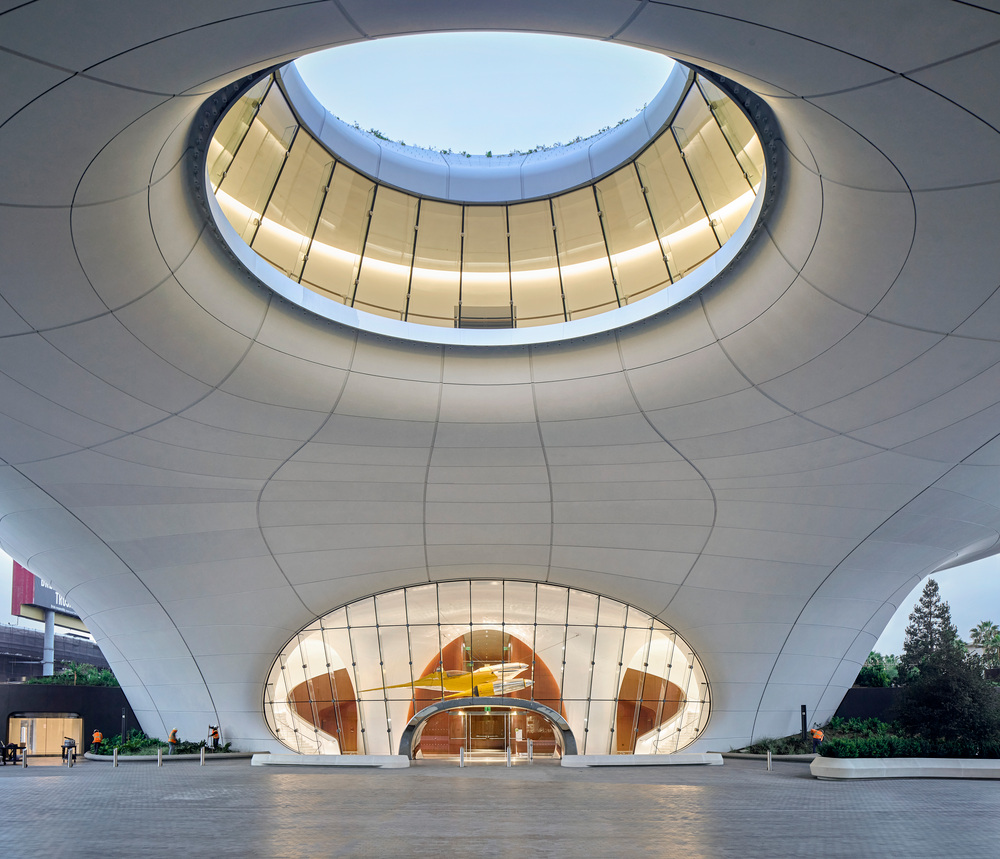
Photo: Hufton Crow
Foremost, the first attraction of the museum is the museum itself, a massive modern cloud hovering over the park in South LA. Where Lucas’s own Skywalker Ranch hides behind Victorian roofs in the hills of Marin County, the museum does the opposite: you see the building before you understand it. Ma Yansong of MAD Architects designed something closer to a landform than an architecture, a pale, sole-shaped, biomorphic mass that seems to hover above the grass, lifted off the ground so the street flows underneath it. A museum built by George Lucas that didn’t ooze Star Wars wouldn’t be the same. It looks the part, and once inside it feels it too, the ultra-wide curved windows recalling the hangar bays ships launch from. Its skin is a mosaic of fiberglass panels, each one shaped differently, cut by robots and finished by hand, stitched into a single continuous surface with no right angles to rest your eye on. Beneath it sits the public plaza. Ma says he wanted it “as light and free as a cloud, or a dream.”
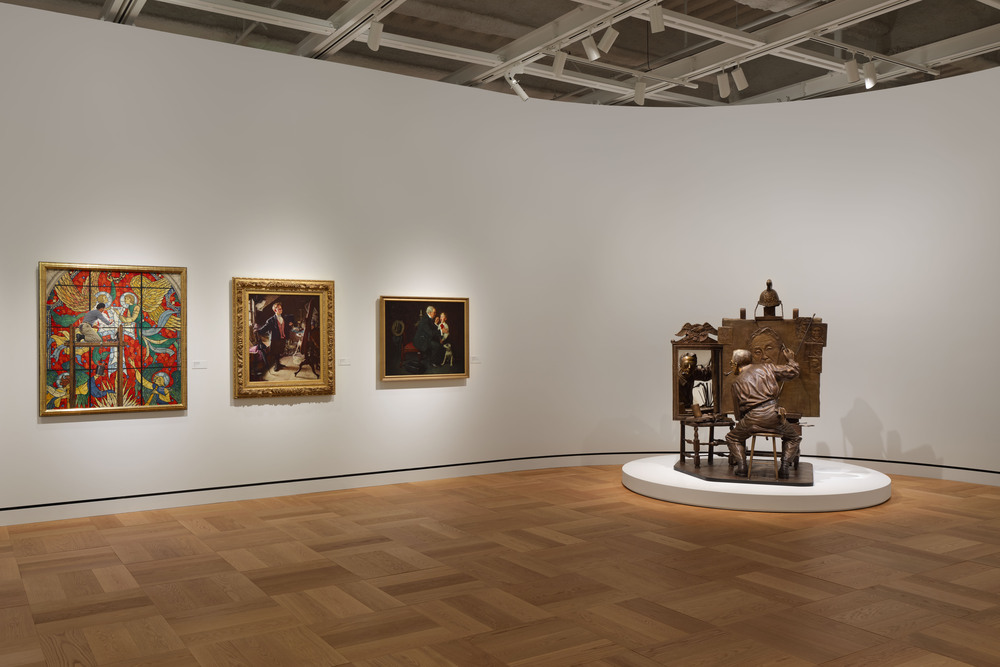
Photo: Paul Salveson
If the building is a cloud, the glass elevators are the ride up to Bespin’s Cloud City: a slow, see-through ascent from the lobby into the work. Up top, there are no hierarchies, just one path that loops through the rooms, letting a Renaissance painting, a Sunday comic and a sci-fi paperback cover sit in the same sentence. The galleries are organised less by period than by myth: love, family, community, adventure, the stories we keep retelling in new costumes. The everyday-life rooms move through childhood, school, sport and work, with Rockwell as the obvious anchor. The comics section is deep, from Jack Kirby and Frank Miller to Alison Bechdel and Marie Severin, with manga given its own space. Murals by Diego Rivera, Judith F. Baca and JR and Banksy bring the street indoors. And the “narrative forms” galleries are where it gets gloriously unashamed: the airbrushed fantasy of Boris Vallejo and Julie Bell hanging in the same museum as Georges Méliès, the magician who first put a rocket in the moon’s eye. Nothing here apologises for being popular.
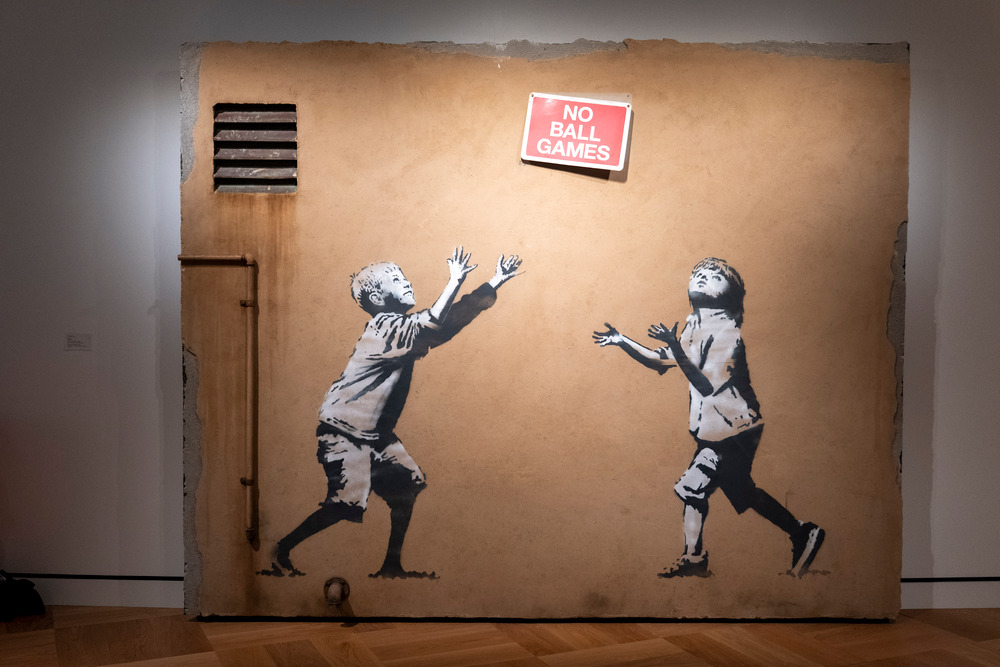
Photo: Lou Caltabiano
The biggest surprise sits almost hidden on the fifth floor: two walls of Banksy’s stenciled murals, the work of an artist who made his name on walls nobody gave him, now hanging in a museum. It’s no loan or quiet acquisition, either. Banksy worked personally with Lucas on the pieces, and left a new one behind for good measure: a pair of stone lions, the kind that guard courthouses and bank steps, sitting there looking very pleased with themselves, one with its muzzle smeared in blood. The lion tamer is gone, and his hat lies on the floor as the only trace.
Read more ...
 1 2