


ETTORE SOTTSASS: DESIGN BEGINS WHERE MAGIC BEGINS
HAPPENINGText: Alma Reyes
The 1980s was an era of resistance against social conformity. Heightened consumerism, widespread use of personal computers, and a simmering pop culture infiltrated the world of design — from furniture to graphics, products, illustrations, and architecture. This phenomenon called for radical creativity, boldness, and vigorous color schemes. Perhaps no other designer embraced unconventionality and unpredictability during this age more than Italian maestro Ettore Sottsass (1917-2007). The formation of his trailblazing Memphis collective in 1981 brought renowned designers, architects, and artists together to shed a new light on postmodern design, which fostered asymmetry, distortion, sculptural creations, and emotional expression.
Running until October 4th this year at Artizon Museum, “Ettore Sottsass: Design begins where magic begins” presents Sottsass’ first major retrospective in Japan, and the museum’s initial full design exhibition. The showcase comprises over a hundred pieces of furniture, ceramics, glassware, office equipment, photographs, and drawings from the Ishibashi Foundation Collection. Through a chronological survey of the designer’s achievements from the 1950s until his death, Sottsass demonstrates a free and stimulating design ideology that supports the exhibition’s theme of bringing “magic” to design. As the designer stated, “Design begins where improvement by rational processes ends, and where improvement by processes of magic begins.”
The first chapter begins in the latter half of the 1950s when Italy witnessed unprecedented economic growth following World War II. Dubbed the Economic Miracle, the period encouraged the advancement of industrial design, which brought manufacturers and designers together to produce goods on a mass scale. During this time, Sottsass was building his career as an architect and designer, and began collaborating with Italian manufacturers. One of these was the Tuscan furniture maker, Poltronova. Sottsass became the company’s artistic director, injecting elements of art into the products.
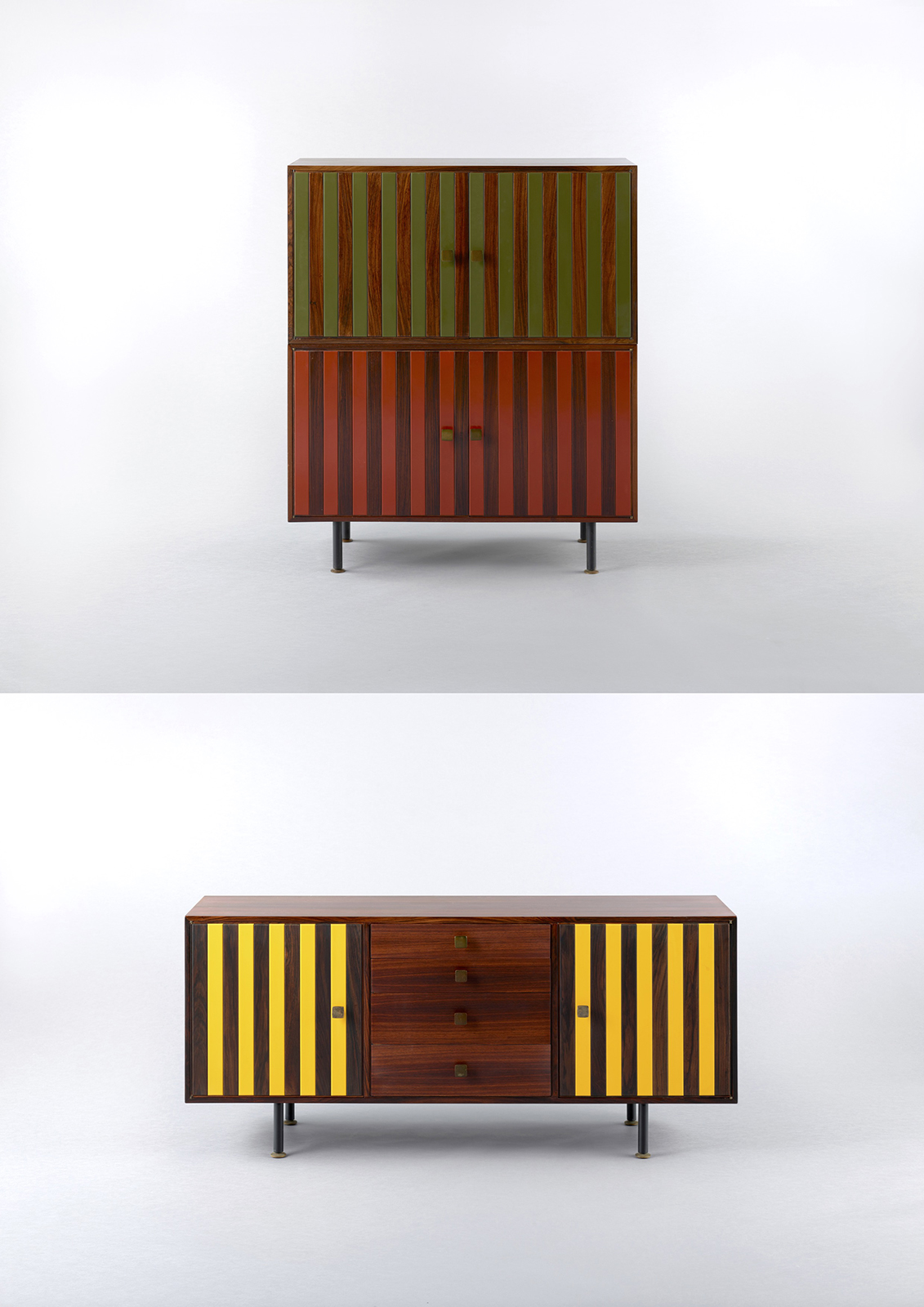
Ettore Sottsass, Top: Double-bodied Sideboard (Model), 1957-58 (design) / 1959 (produce), (Produced by Poltronova) © Erede Ettore Sottsass / Bottom: Sideboard (Model MS. 180), c. 1959-63 (design/produce), (Produced by Poltronova) © Erede Ettore Sottsass
On show are “Mobile” (1957-58/1959) and “Mobile MS 180” (c. 1959–63), the first furniture series Sottsass produced for Poltronova. The elegantly lacquer-finished rosewood cabinets in red, green, and yellow stripes with cylindrical base legs exude cheerfulness and sophistication. Sottsass’ involvement with Poltronova lasted until 1974, resulting as well in the modular bench “Lucrezia with Frame” (1964) and the multicolored cabinet series “Superbox” (1966), as displayed.
Olivetti, the famous typewriter manufacturer, was another company Sottsass designed for from 1958 to around 1980. The “Valentine” (1968) was one of his most popular creations. Its vivid red color and two orange ribbon spools provide delightful accents to the minimalistic design. The visible internal mechanism elicits curiosity while the matching scarlet carrying case serves a dual function as both protection and a work surface. Sottsass’ concept was for the equipment “to be used anywhere except the office… to keep amateur poets company on quiet Sundays in the country…” (Ettore Sottsass: “Design begins where magic begins” catalog) Together with co-designer Perry King, he received the prestigious Compasso d’Oro Award in 1970 for this revolutionary pop-art product.
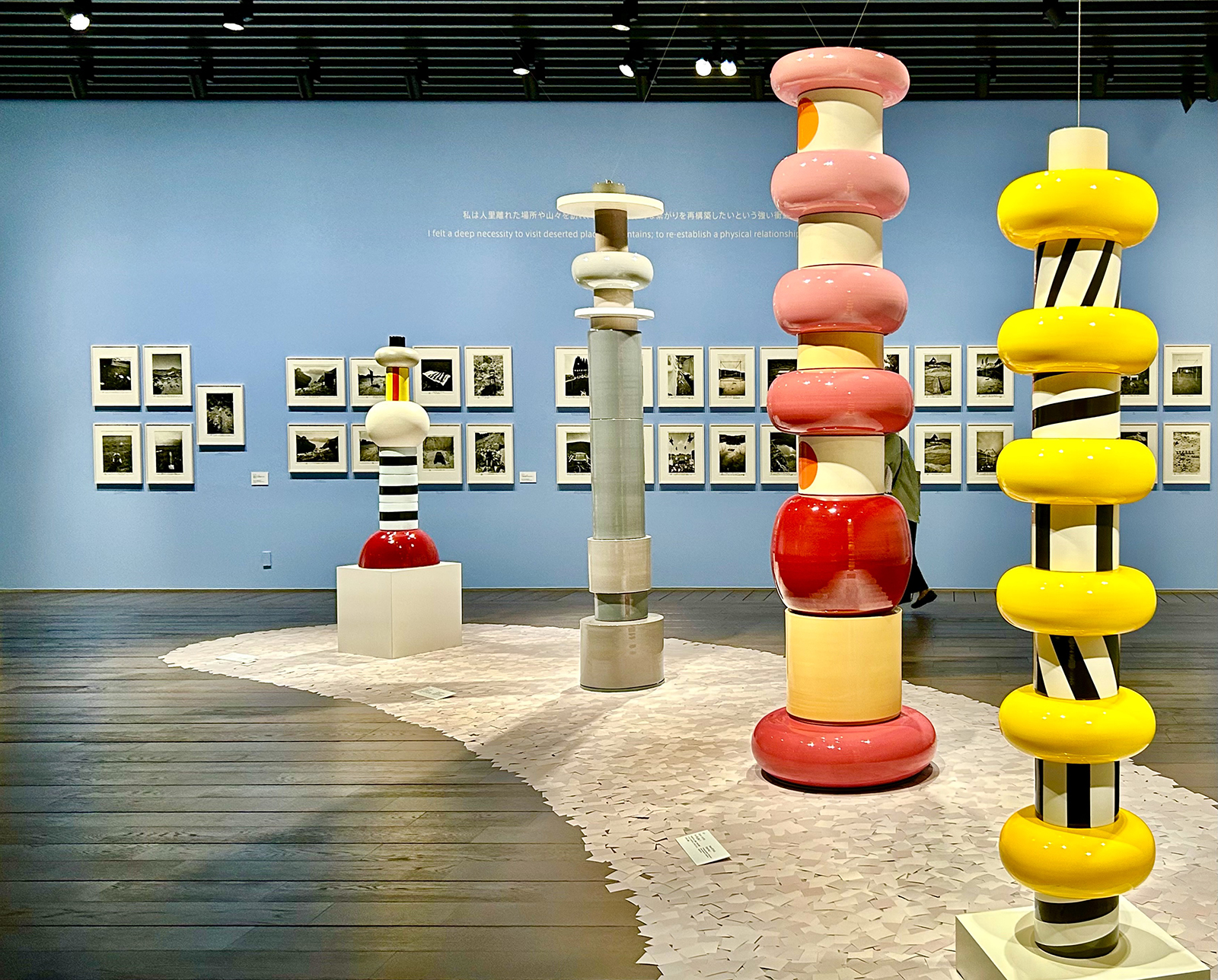
Installation view, “Ettore Sottsass: Design begins where magic begins,” Artizon Museum, Photo: Alma Reyes
The 1960s section reflects a more experimental approach in Sottsass’ works as Italy navigated social upheaval and clamored for peace, civil rights, and women’s liberation. He interpreted these rebellious times through ceramic creations. In 1961, he travelled to the rural villages and ancient ruins of South Asia, which introduced him to the mystical and spiritual world. Moreover, while he was recuperating from an illness contracted after his Asian sojourn, the hallucinogenic effects of his medication carried him deeper into the metaphysical realm. He envisioned that large columns consisting of stacked ceramics would resemble a small temple existing in a pop, psychedelic outer world. For him, the play of colors and geometric shapes helped people fathom the chaos of modern society. The glazed ceramic “Totem” series, inspired by Buddhist stupas, was born. Decorated with brightly colored rings and stripes, they acted as instruments of meditation.
Read more ...