


HIROSHI SUGIMOTO: EXTINCTION
HAPPENINGText: Alma Reyes
With the advent of digital and smartphone technology, the essence of photography has plunged into a wholly artificial realm, questioning the very nature of realism. For Hiroshi Sugimoto, one of Japan’s most respected multidisciplinary contemporary artists, “true” photography has fallen into extinction. As a grounded guru of silver halide photography, Sugimoto has adapted to the diminishing value of traditional craft, but continues to uphold the evidentiary properties of art and photography that he has always nourished since the dawn of his remarkable career. His distinguished awards include the Hasselblad Foundation International Award in Photography (2001), the Medal with Purple Ribbon (2010), and a recognition as Officier de L’Ordre des Arts et des Lettres in France (2013), among others.
The National Museum of Modern Art, Tokyo proudly presents “Hiroshi Sugimoto: Extinction” until September 13 this year. The large solo exhibition, since 2005 (held at the Mori Art Museum, Tokyo), features approximately sixty of the master’s gelatin silver photographs from the late 1970s until the present. On the museum’s third floor, a satellite exhibit showcases “Theater, Seascape, and Sugimoto Notebooks/Seeing the Wind” for the first time, highlighting thirteen masterpieces from the MOMAT Collection. The notebooks document personal thoughts about his works and their developing processes, casting light on Sugimoto as a craftsman.
The theme of extinction primarily dwells on Sugimoto’s views regarding the apparent departure of gelatin silver media and his own endeavors as an artist. Simultaneously, it supports the philosophy that everything has a beginning and an end. The artist’s works prove that certain valuable expressions can only be conveyed through silver halide photography, and that humanity itself is not immune to extinction.
Sugimoto’s initial aspiration was to become an artist, but he gained recognition as a photographer along the way. He resolved to make photography the backbone of his contemporary art. While shooting photographs of architecture, he also studied the field. His major design achievements include the Enoura Observatory in Odawara (2017), Tea House Imameido in New York (2011), and the Restoration of Go’o Shrine in Naoshima (2002). He has also been engaged in the performing arts, art directing “Engyoji Temple x Hiroshi Sugimoto: Noh Climax” (2022) in Hyogo and “Sugimoto Bunraku Sonezaki Shinju, The Love Suicides at Sonezaki” (2019) in New York. Moving to New York at age 22 and continuously shuttling between Japan and the U.S. provided Sugimoto with a deep sense of diversity. This cross-cultural fluidity fostered his receptivity to various creative disciplines and sharpened his philosophical approach to the existential and spiritual facets of objects and spaces.
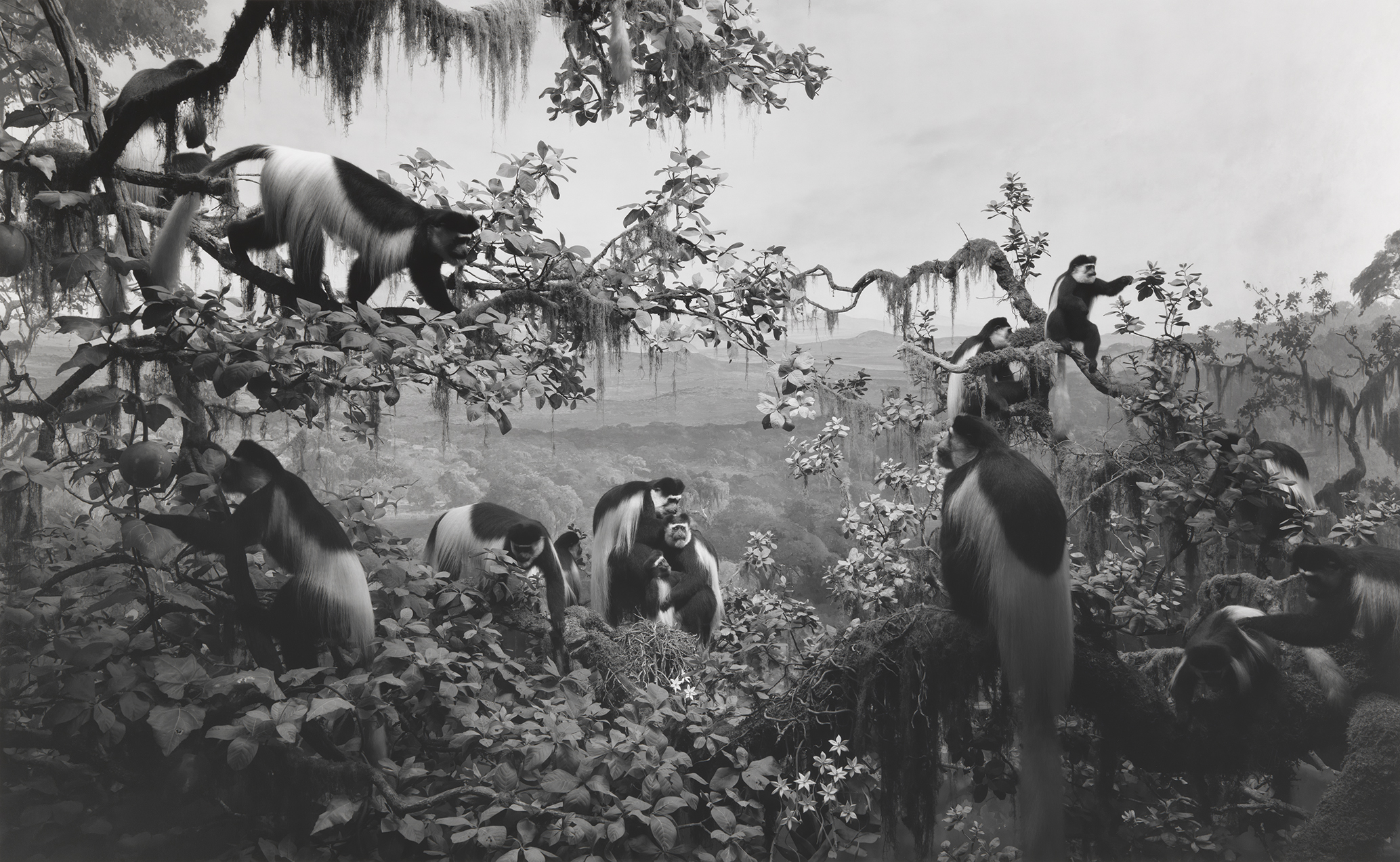
Hiroshi Sugimoto, White Mantled Colobus, 1980 © Hiroshi Sugimoto/Courtesy of Gallery Koyanagi
The exhibition is grouped into Sugimoto’s thirteen photographic series. In the first chapter, “Time, Light, and Memory,” the series “Diorama,” “Theaters,” and “Seascapes” introduce the artist’s early works in the 1970s and 1980s. “White-mantled Colobus” (1980) from the Diorama series is part of the National Gallery of Canada’s permanent collection. At first glance, we view the scene as though it were taken from an actual jungle. However, Sugimoto has employed a large-format camera and long exposure technique to freeze the picture of moving objects and flatten the diorama’s perspective. This method transformed the staged animals into hyper-realistic images, defining the boundary between reality and duplication. Viewers become conscious of their proximity to the vitality or mortality of wildlife, and the layers of detachment that separate them from an existing moment. He explains, “…the stuffed animals positioned before painted backdrops looked utterly fake, yet by taking a quick peek with one eye closed, all perspective vanished, and suddenly, they looked very real.”
Photographs of dark and lonesome-looking theater halls also symbolize an era of extinction when digitization dominated human forms of entertainment.
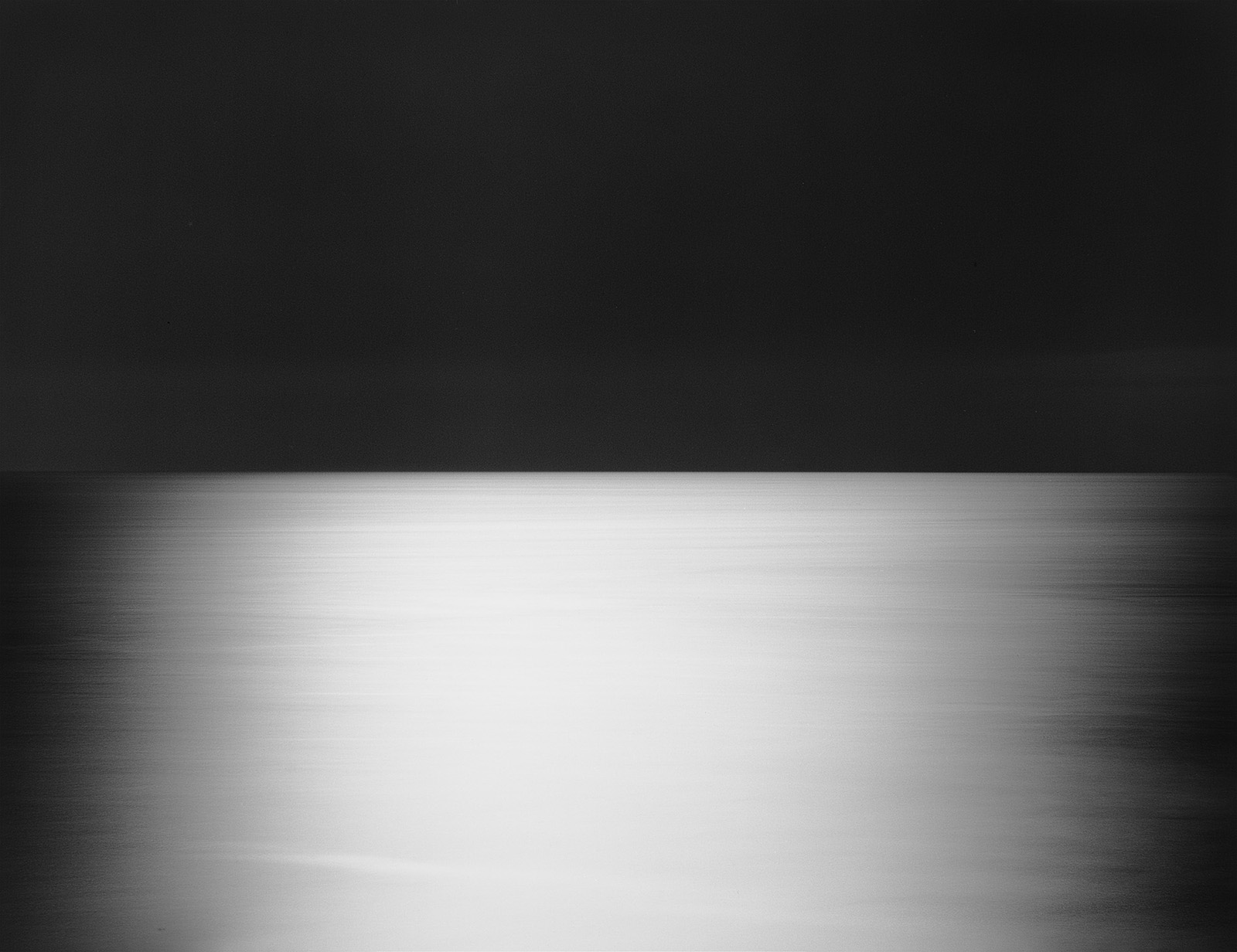
Hiroshi Sugimoto, Bay of Sagami, Enoura, 2025 © Hiroshi Sugimoto/Courtesy of Gallery Koyanagi
Seascapes are iconically identified with the artist, who has traveled to remote corners of the world since 1980 to capture fleeting moments where the sky meets the sea. The monochrome series further emphasizes the unwavering presence of landscapes that have existed for billions of years, transporting visitors back to prehistoric times. In “Bay of Sagami, Enoura” (2025), taken at the Enoura Observatory, the horizon splits the ocean and the sky exactly in the center of the frame, creating two equals. The pitch-dark sky contrasts heavily with the pale, grey water and gentle ripples. The black shadow impact on the sides lift the serene sea majestically into focus. No boats, birds, or other additional elements interfere with the meditative panorama, except the primeval constituents of water and air. Sugimoto reflects, “Every time I view the sea, I feel a calming sense of security, as if visiting my ancestral home; I embark on a voyage of seeing.”
Read more ...