

GENER8ION: VISIONS OF 2034
HAPPENINGText: Victor Moreno
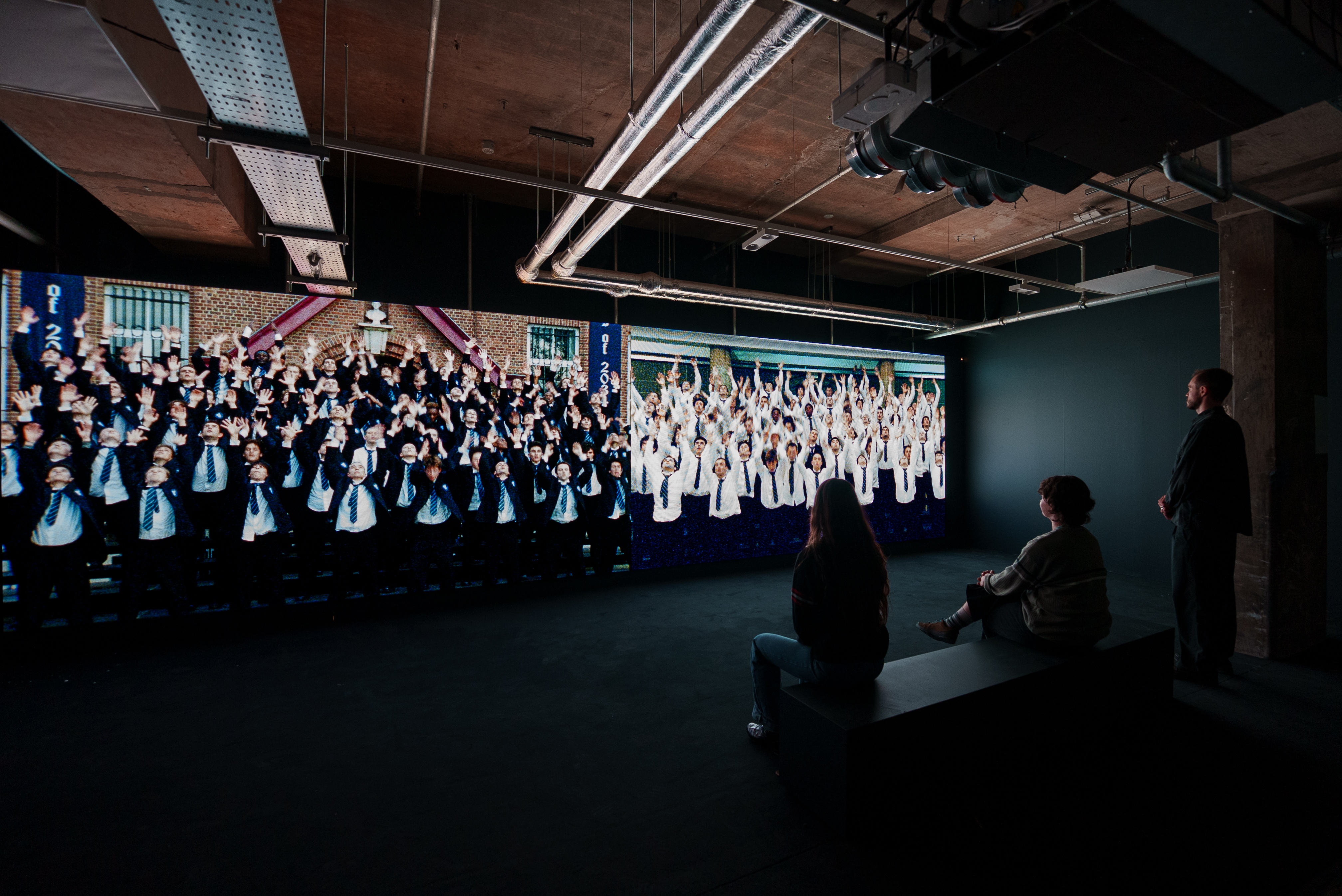
Filmmaker Romain Gavras and music producer Surkin build worlds where music and image feed each other until you can’t tell which came first, a track summons a film, a film feeds back into the track. GENER8ION: Visions of 2034, their first major exhibition, fills 180 Studios in London, and opened on the same day as their debut album Love & Tears. Ten audiovisual works, each set in a near-future city, each built around a song. Romain Gavras has a signature – son of acclaimed director Costa-Gavras – first captured international attention with the raw controversy of Justice’s “Stress” music video, tracking a violent youth gang through the Parisian suburbs in a distinctly modern, Kubrickian vision. Since then, his hyper-stylized lens has shaped iconic Adidas campaigns, visuals for M.I.A., Jamie xx, Jay-Z, and Kanye West, as well as luxury fashion films for Dior and Louis Vuitton. Joining forces with composer and electronic producer Surkin (Benoît Heitz) a defining figure of French Touch 2.0 who emerged from the Institubes label, co-founded Marble, and scored Gavras’s Athena, the pair form the core of GENER8ION. Together, they transform London’s 180 Studios into a living laboratory of art, sound, and performance, joined by high-profile collaborators including Yung Lean, 070 Shake, Foals’ Yannis Philippakis, actress Charlize Theron, and choreographer Damien Jalet. Gavras’s work is celebrated for its striking cinematography, this time brought to life alongside Lara Perrotte and Matias Boucard for the viral piece “Storm I & II”, while Nicolas Loir served as Director of Photography for “Neo Surf”.
© 180 Studios
The show drifts through a near future that lingers rather than arrives: ten peripheral dystopias, futures glimpsed from the margins, shaped less by collapse than by distortion. Something shifts in each one: the gestures of youth, the reflexes of pleasure, the machinery of control. The world becomes a network of anomalies, familiar but off. Seven of the works are new premieres; the rest are pulled from the GENER8ION archive, older videos that now read as predictions. At the heart of it Gavras asks one question: what survives, and what doesn’t? We’ll walk through each of the ten, in the order the building takes you.
The first work opens the exhibition on 180 Studios’ ramp. Right away you’re met with a Soviet-like astronaut aesthetic: cosmonauts departing for space, set against a 1973 interview with Hannah Arendt. Where Idaho’s separatists later insist heaven lies beneath our feet, Gavras looks the other way, upward, at the oldest dream of all: leaving Earth entirely. One shot stays with you: the camera holding on the launched rocket as it hangs in the sky like a star, tracking it until it vanishes.
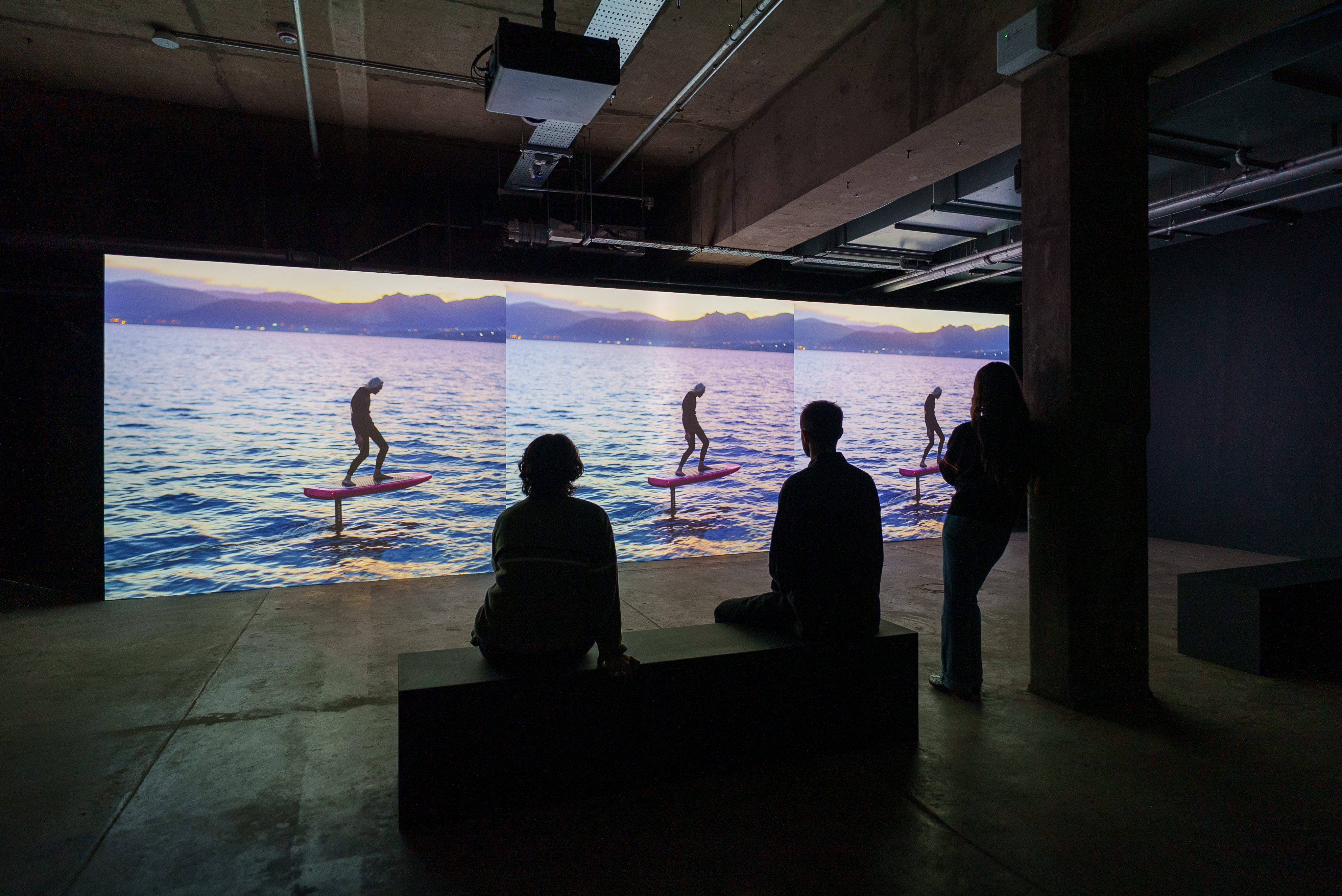
Three screens project the film at once, sometimes mirroring each other, sometimes pairing like the spread of a hardcover magazine, a vast digital one. The exclusion zones ringing Athens have become playgrounds: after toxic algae blooms poisoned the coastline in the late 2020s, the shoreline was abandoned to ruin, and the young have claimed it back, treating the contaminated waterfront as both turf and arena. The result sits somewhere between a fashion film and a dreamy art-house short. Gavras uses the landscape’s natural textures and his camera angles to pull the viewer into this neo-apocalyptic world, right down to the closing shot, the surfer leaving the frame on a foilboard.
© 180 Studios
An in-between installation, bridging one room and the next. No screen this time, instead, a mannequin of a Korean guard set before ten ARP 2600 synthesizers breathing out a synthetic version of nature, threaded through a canopy of cascading vines. At the centre the guard sleeps on the job, trading watchfulness for dreaming, the machine drifting off into visions of the living world it was built to mimic.
A striking vision of a volcano in full eruption, one foot in high-end nature documentary, the other in stylised narrative. The camera flies in close above this display of Mother Nature, cut against vast ultra-wide shots of smoke rising from the fields. One question lingers: how did Gavras keep the equipment from melting into the lava? Worth knowing.
I still remember the first time I saw Justice’s Stress, that 21st-century hunger for ultra-violence, Kubrick à la mode. This R-rated piece, first made for M.I.A. in 2010, runs in the same vein and now reads as a prophecy. Out on the city’s east side, police trial experimental methods of “behavioural pacification” on the Reds, an armed group the state branded a terrorist organisation in 2033. M.I.A. feeds the frenzy and discomfort, building to a climax, (spoiler) in which one of the kids used to test the methods runs across a minefield and is blown to shreds in front of the viewer, the goriest moment of the whole exhibition.
Read more ...
 1 2
1 2