


YBA & BEYOND: BRITISH ART IN THE 90S FROM THE TATE COLLECTION
HAPPENINGText: Alma Reyes
The late 1980s through the early 2000s was a tumultuous era in Britain, sparked by radical changes in the political, economic, and cultural scenes. The country fell into a dark recession in the first half of the 1990s, but gradually recovered with the upsurge of the Internet and mobile phones. The so-called “Cool Britannia” phenomenon that emerged in the mid-to late 1990s witnessed vibrant energy in British fashion, music, and art.
The Young British Artists (YBAs), a new wave of creators who stood out during this period, broke the rules of standard expression and, instead, bravely delivered unconventional concepts in contemporary art using mixed media and techniques. They questioned all facets of modern art and its influence on society’s complexities. Artworks touched on popular culture and personal stories, sometimes inducing shock and controversy. Consequently, this bold and daring direction molded the future generation of free creativity and led to the launch of the Tate Modern in 2000.
The National Art Center, Tokyo is presenting “YBA & BEYOND: British Art in the 90s from the Tate Collection” until May 11. The colossal exhibition gathers around a hundred works in multifarious media — painting, sculpture, photography, film, video, and installations — by approximately sixty young artists and internationally renowned figures who lived and worked in Britain at the time. Each section highlights a specific artist’s film work presented as “Spotlight.” The exhibition theme revolves around cultural and gender identity, public health, racial violence, societal evolution, and the urban environment.
The first gallery reveals the huge, three-paneled “Second Version of Triptych 1944” (1988) by distinguished painter, Francis Bacon. The raw emotions of rage and brutality depicted by the three figures painted over crimson red backgrounds speak of the extreme turmoil endured by young artists during the Cold War.
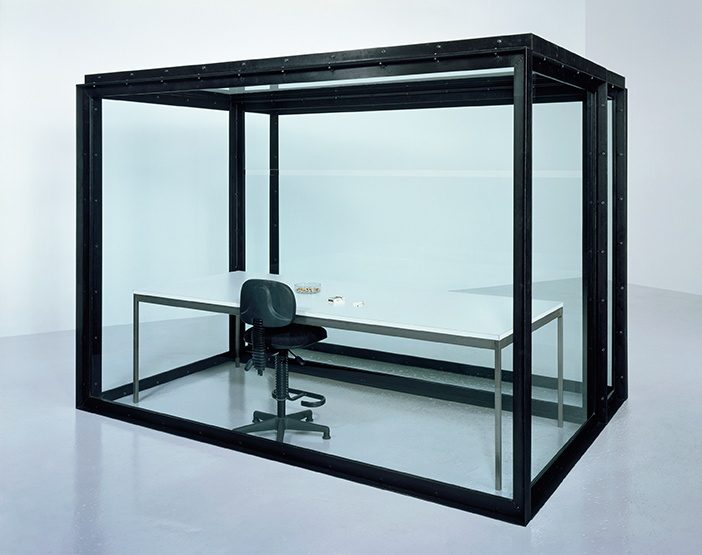
Damien Hirst, The Acquired Inability to Escape, 1991, Photographed by Prudence Cuming Associates © Damien Hirst and Science Ltd. All rights reserved, DACS/Artimage 2026, Tate Collection
In the middle of the hall is a giant glass and steel encased installation by one of the world’s pivotal artists today, Damien Hirst. “The Acquired Inability to Escape” (1991) illustrates an office setup trapped inside a glass box. The packet of cigarettes, an ashtray, and a lighter set on the desk serve as metaphors for death or suffocation, implying a worker spinning in an unescapable cycle. Viewers face the reality of the fragility of the everyday routine of social pressure. The work was unveiled at the 1991 “Broken English” exhibition in London, a significant showcase that ignited the YBA movement.
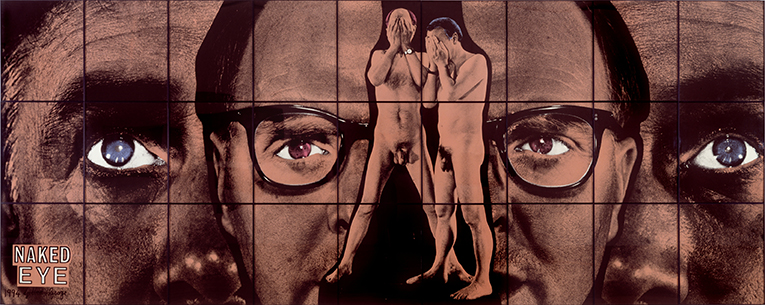
Gilbert & George, Naked Eye, 1994, Photo: Tate © Gilbert & George, Tate Collection
In the next room, the provocative “Naked Eye” (1994) by Gilbert & George from Italy and the UK stretches over six meters long with twenty-seven photographs combined, pinning on a double meaning of “eye” and “I.” The two artists portray themselves naked and covering their eyes, while their close-up faces occupy the entire background. Gilbert & George, who have been active since the 1960s, confront the politics of sexuality, particularly at the height of the AIDS crisis in the late 1980s and 1990s.
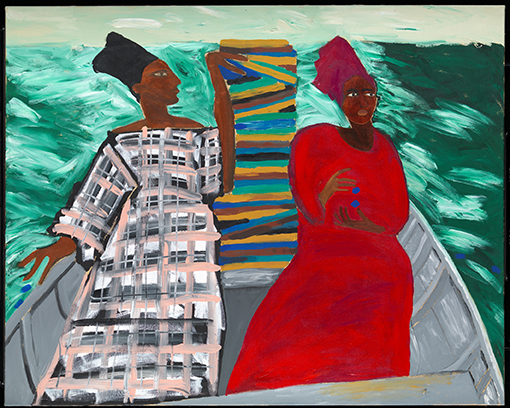
Lubaina Himid, Between the Two My Heart is Balanced, 1991, Photo: Tate © Lubaina Himid, Courtesy Hollybush Gardens and Greene Naftali, Tate Collection
Part of the YBA’s endeavors is the integration of creators with roots in the Caribbean, South Asia, and Africa. Lubaina Himid, born in Zanzibar (former British protectorate), moved to the UK after birth, and has contributed immensely to British art. She will represent the country at the 2026 Venice Biennale this year. The colorful and brilliant “Between the Two My Heart is Balanced” (1991) characterizes two black female migrants who have discarded piles of maps (sandwiched between them) used by European white men in sea voyages. The message defies the navigation system and seafaring knowledge generally dominated by white men.
Read more ...