


RON MUECK
HAPPENINGText: Alma Reyes
The upright sculpture, “Ghost” (1998/2014), stands around two meters tall, illustrating a young girl in a black swimsuit, leaning against the wall. Her arms fall to her sides, slightly hidden behind her buttocks. Her fists are tightly clenched as though cringing in embarrassment. She exudes an air of awkwardness and self-consciousness. Her eyes stare almost in fright. One may feel faintly disturbed by her exaggerated height and lengthy legs, emerging like a ghost in disguise.
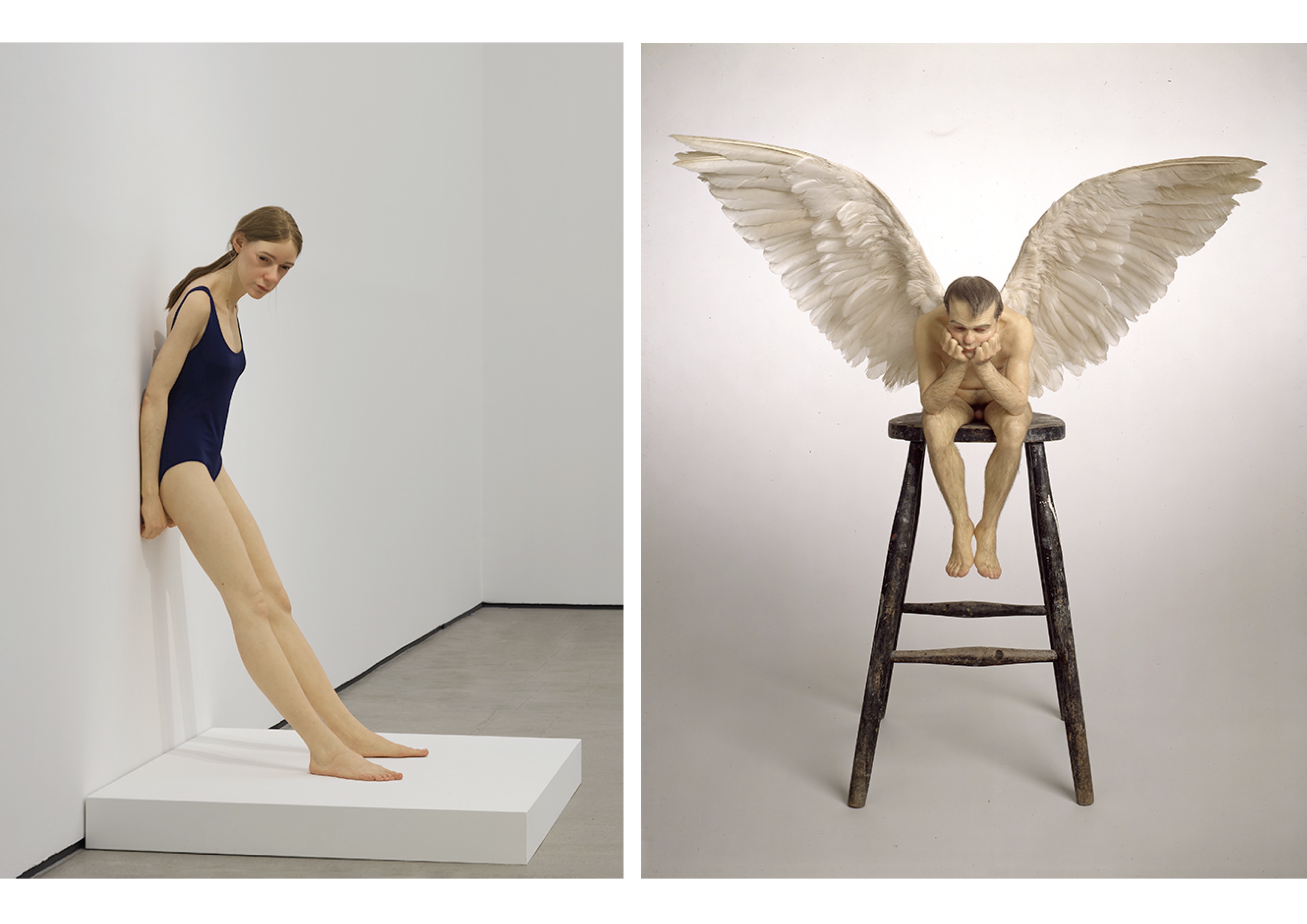
Left: Ron Mueck, Ghost, 1998/2014, YAGEO Foundation Collection, Taiwan, Installation view: Ron Mueck, National Museum of Modern and Contemporary Art, Seoul, 2025, Photo: Nam Kiyong, Photo courtesy: Fondation Cartier pour l’art contemporain, National Museum of Modern and Contemporary Art, Korea / Right: Ron Mueck, Angel, 1997, Private collection, Photo courtesy: Anthony d’Offay, London
Another Japan premiere piece is “Angel” (1997), one of Mueck’s early creations. The man with large, white wings sits pensively with his hands under his chin, seemingly caught in a moment of dissatisfaction or boredom. The artist drew inspiration from the image of an elderly winged man in Giovanni Battista Tiepolo’s “Allegory with Venus and Time,” seen at the National Gallery in London.
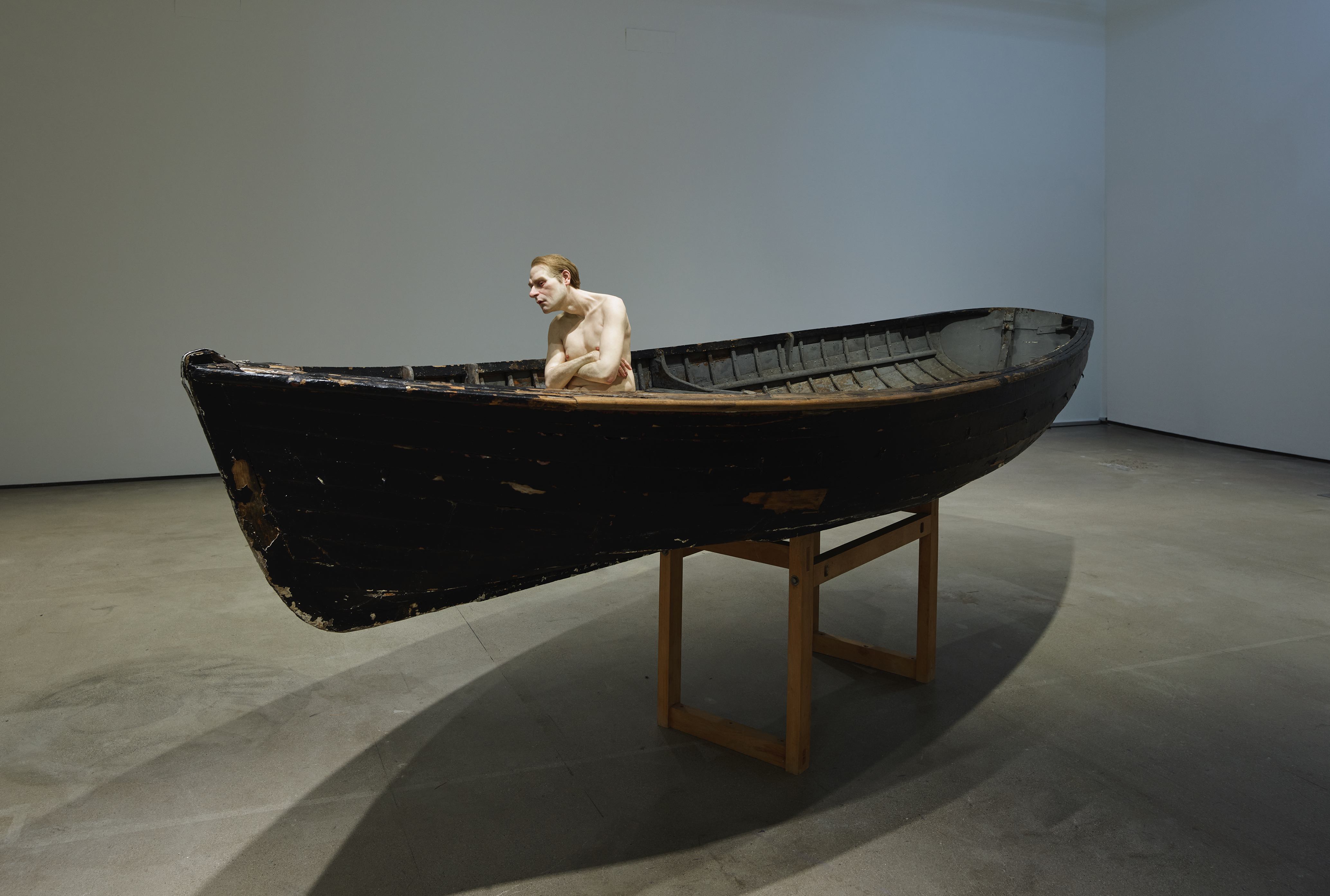
Ron Mueck, Man in a Boat, 2002, Private collection, Installation view: Ron Mueck, National Museum of Modern and Contemporary Art, Seoul, 2025, Photo: Nam Kiyong, Photo courtesy: Fondation Cartier pour l’art contemporain, National Museum of Modern and Contemporary Art, Korea
Mueck also employs contrast in scale, as shown in “Man in a Boat” (2002). The small, naked man appears to shrink in the large, elongated boat stretching over four meters long, creating a disproportional perception. The boat has no oars, which implies that it may have drifted from somewhere, leaving the man, with arms crossed, desolate, uncertain, and perhaps, resigned. He leans to the right, which may possibly denote the boat swaying on the water. The work suggests a “psychological portrait,” delving into an inner world of private emotions and solitude. During this period when Mueck worked at the National Gallery in London, sculptures revolved around the themes of “birth” and “motherhood.” The painting, “The Immaculate Conception” (1618-1619) by Diego Velazquez delineates a small ship to symbolize the Holy Mother as a vessel for the birth of Christ, which had struck Mueck immensely.
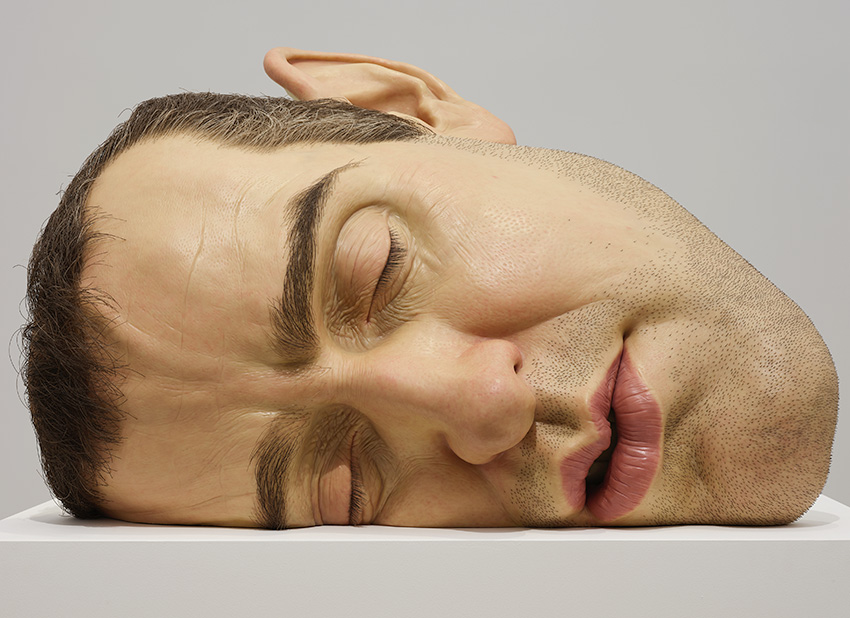
Ron Mueck, Mask Ⅱ, 2002, Private collection, Installation view: Ron Mueck, National Museum of Modern and Contemporary Art, Seoul, 2025, Photo: Nam Kiyong, Photo courtesy: Fondation Cartier pour l’art contemporain, National Museum of Modern and Contemporary Art, Korea
Shifting one’s perspective from a minuscule subject to a colossal head sculpture, the visitor is surely mesmerized by “Mask II” (2002), Mueck’s spellbinding self-portrait magnified four times. The man appears asleep or trapped in a dream. However, when viewed from the rear, the head is hollow like a mask, and one feels almost deceived by the camouflage of realism. The masterpiece typifies Mueck’s brilliant illusional technique of balancing reality and unreality. Again, the delineation of the lips, chin, and lines circling the closed eyes is impeccable.
Read more ...