


SOL LEWITT: OPEN STRUCTURE
HAPPENINGText: Alma Reyes
By the 1980s, LeWitt began to apply ink wash to emit vibrant colors in his wall drawings. This is evident in the large “Wall Drawing #770 Asymmetrical pyramid with color ink washes superimposed” (first installation, 1994). Over the blue background, five layers in red, yellow, brown, green, and orange form pyramids of varied angles. The pyramidal scheme was said to have stemmed from the works during the Quattrocento era (15th century) in Italy, a time that LeWitt immensely admired during his stay in the country.
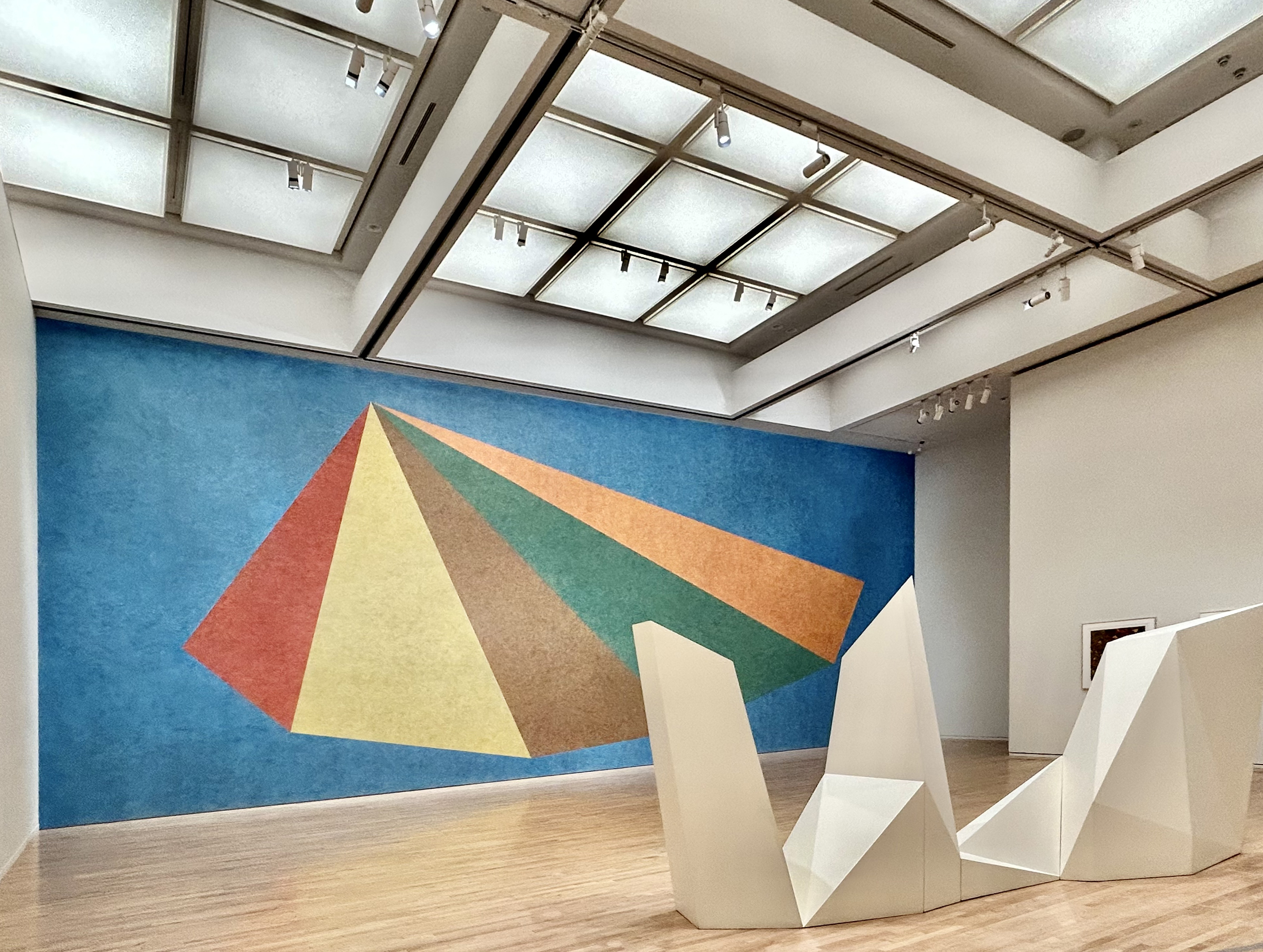
Sol LeWitt, Wall Drawing #770 Asymmetrical pyramid with color ink washes superimposed, First installation in September 1994, Current installation in December 2025 by Andrew Colbert, Yuki Fujita, Shuhei Fukushima, Yasuo Hagiwara, Harumitsu Kasama, Shugo Kashiwagi, Takafumi Kijima, Sungho Koh, Gaku Okahara, Anna Violette Rousseau, Noriko Takeichi, Rintaro Unno, and Remi Verstraeten, LeWitt Collection, Chester/Complex Forms #6, 1987, Collection of the National Museum of Modern Art, Tokyo, Installation view of the exhibition “Sol LeWitt: Open Structure” at the Museum of Contemporary Art Tokyo, 2025. © 2025 The LeWitt Estate/Artists Rights Society (ARS), New York. Courtesy Paula Cooper. Photo: Alma Reyes
The multilateral installation, “Complex Forms” (1990), standing before the colored pyramid-designed wall projects a stark contrast with the pyramids. Made of gleaming white polygonal shapes, it confounds basic geometry, suggesting a mysterious degree of volatility.
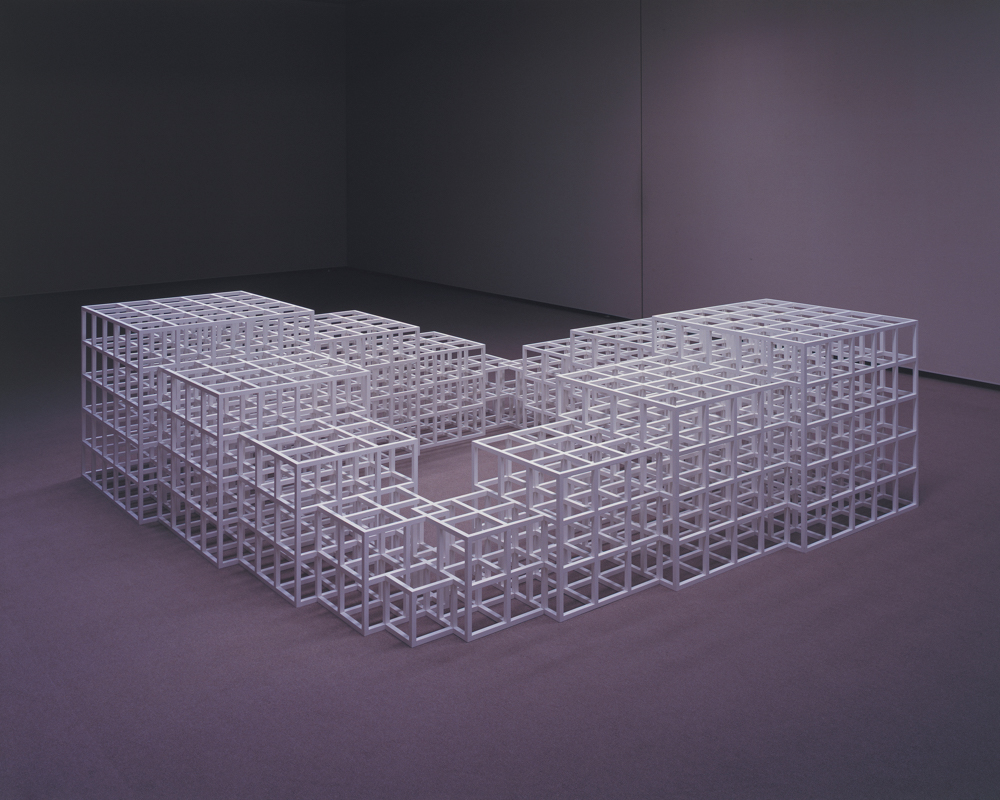
Sol Lewitt, Structure (One, Two, Three, Four, Five as a Square), 1978-80, Collection of Shiga Museum of Art. © 2025, The LeWitt Estate/Artists Rights Society (ARS), New York. Courtesy Paula Cooper Gallery
Two huge, spellbinding installations are worth surveying. “Structure (One, Two, Three, Four, Five as a Square)” (1978-80) clearly delineates the artist’s “open structure” theory. White-painted modular, skeletal cubic forms denote a serial progression, wherein the number of components increases from one to five in height and width. The design is founded on a mathematical sequence, following rules rather than emotion.
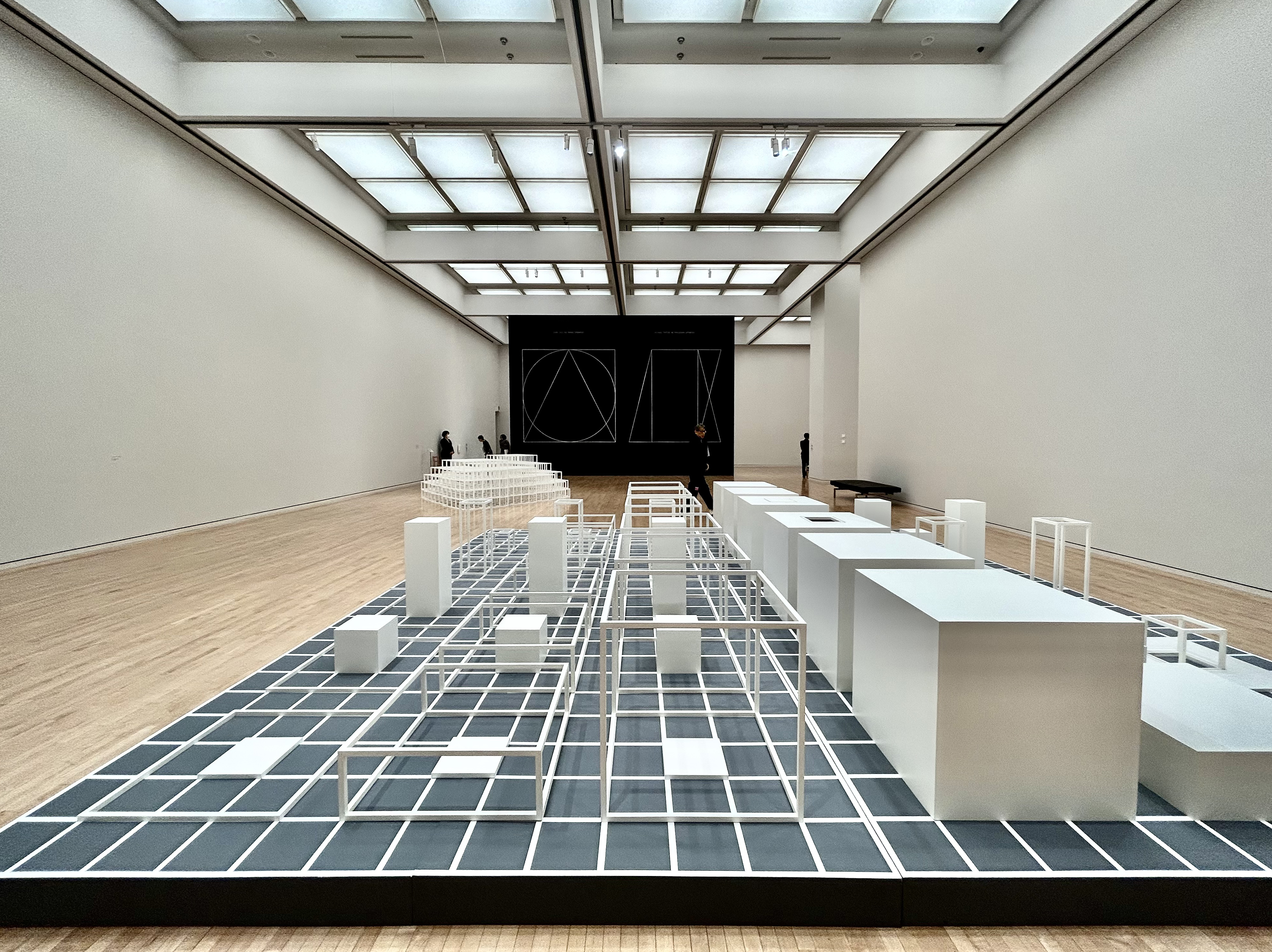
Sol Lewitt, Foreground: Serial Project #1 (ABCD), 1983, Collection of Chiba City Museum of Art, Installation view of the exhibition “Sol LeWitt: Open Structure” at the Museum of Contemporary Art Tokyo, 2025. © 2025 The LeWitt Estate/Artists Rights Society (ARS), New York. Courtesy Paula Cooper. Photo: Alma Reyes
The other eye-catching installation, “Serial Project #1 (ABCD)” (1983), presents a visual field of combined open and closed enameled aluminum squares, cubes, and extended shapes laid on a dark gray grid that gives depth to the white objects. The work imbues both an intricate and a methodical system that stirs the mind. The precise arrangement of the objects plays with infinite prospects of line, shape, width, and height computations. LeWitt explained, “The serial artist does not attempt to produce a beautiful or mysterious object but functions merely as a clerk cataloging the results of his premise.”
Probing into LeWitt’s conceptual art triggers a rhetoric that perhaps, there is something beyond “beauty” per se, or that what we visualize as aesthetics relies on our own capacity to understand the rudimentary device behind it.
Sol LeWitt: Open Structure
Date: December 25th, 2025 – April 2nd, 2026
Opening Hours: 10:00 – 18:00
Closed on Mondays (except February 23rd) and February 24th
Place: Museum of Contemporary Art Tokyo
Address: 4-1-1 Miyoshi, Koto-ku, Tokyo
Tel: +81 (0)3 5245 4111
https://www.mot-art-museum.jp
Text: Alma Reyes