


SPENCER TUNICK
PEOPLEText: Victor Moreno
Directing hundreds of people moving and responding as one almost like a single organism. What would you say is the most rewarding part of orchestrating those moments?
It is beautiful to see and to be a part of. It’s fascinating to experience the photograph not just as a final result, but to watch it happen live. Seeing the moving bodies suddenly become still is amazing and deeply interesting. It never bores me, which is why I keep doing it. Managing it requires a lot of interaction. You might imagine me with a big megaphone, directing people in the moment, where some understand and some don’t. If people in the back can’t hear, and I’m only using a microphone, I feel like I’m going crazy because I sound so loud to myself, yet the people in the back still can’t hear me. Fortunately, we are using sound systems more and more now, hiding the speakers in different places so everyone can hear a bit better.
How does location shape the experience for both you and for participants?
Sometimes, the human body transforms a location for a fleeting moment, bringing a completely new meaning to the background. For the participants, especially those standing in their own country or city, there is a distinct sense of pride that comes with being nude in a public space. There is also mutual respect. It is being handled in a deliberate way. Not that skinny-dipping is bad, but this isn’t just a casual group skinny-dip. Everyone involved, myself and the participants, tries incredibly hard that morning to create a genuine piece of artwork that resonates. If it carries a message that extends beyond the physical art piece afterward, that message is simply one of joy.
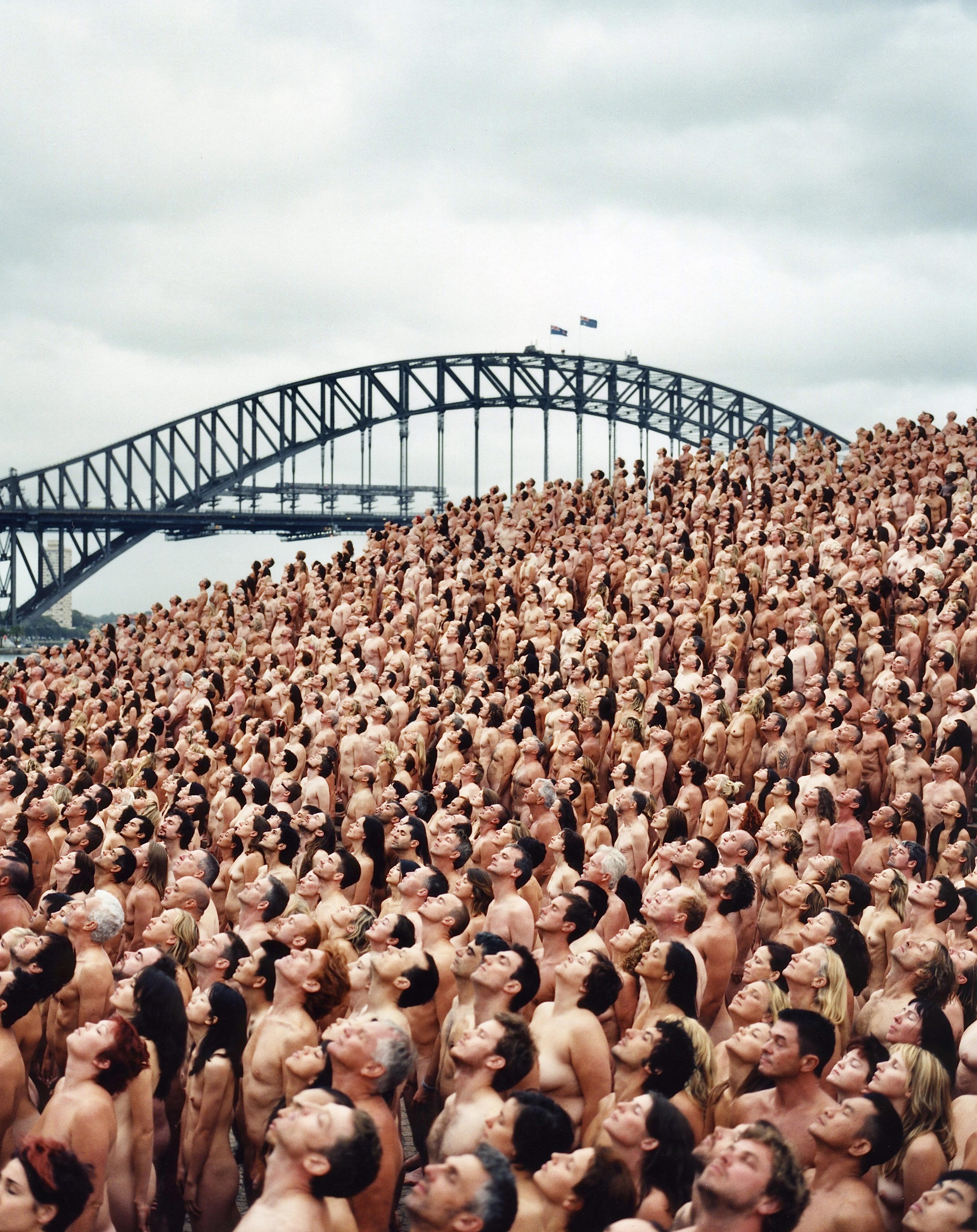
Spencer Tunick, Sydney, Australia, 2010, Pigment print, 121.92 x 152.4 cm, Edition of 6
For your large-scale outdoors installations, do you rely primarily on natural light, or do you work around it?
That’s a good question. I work with natural light and I use a Japanese camera. I don’t show it to you because they don’t give me support (laughs). I use natural light because you can’t light a city so there is nothing just but natural.
You don’t have to put any type of v-flats or diffusers around?
Right, I prefer to shoot early in the morning. I like to work when the sun is still below the horizon and not hitting the participants directly. Instead, it hits the sky, turning the entire atmosphere into a giant lightbox that beautifully diffuses the light. Thanks to modern digital camera technology and advanced image stabilization, I can shoot much earlier now than I ever could with film. I used to rely on Fujifilm 800 ASA film for those early mornings, and when they discontinued it, it was truly one of the saddest days of my photographic life. That loss forced me to transition to digital. Ultimately, it felt like a miracle for low-light photography, allowing me to capture those dim morning hours with ease. But of course, I still miss film. If Fujifilm ever brought back their 800 ASA film, I would absolutely shoot film again, or at least shoot both digital and film.
I’ll make that very clear, just in case anyone at Fuji in Japan is reading this!
Great (laughs)
I guess to work at this scale indoors becomes more complicated.
Yes, it’s more complicated. While I do occasionally work indoors, my passion is predominantly outdoors. I love the scale and the environment of the open air.
Do you have a favourite location or installation that, for whatever reason, turned out to be particularly meaningful either in your career or on a more personal level?
I really enjoy working in New Mexico, particularly out in nature in Los Alamos. There is just something incredibly special about working around hot springs. I love the interplay of water and nature. In fact, one of my absolute favorite photographs was taken in a New Mexico hot spring. I enjoy hot springs so much that I would love to create more work around them in the future, perhaps in Japan.
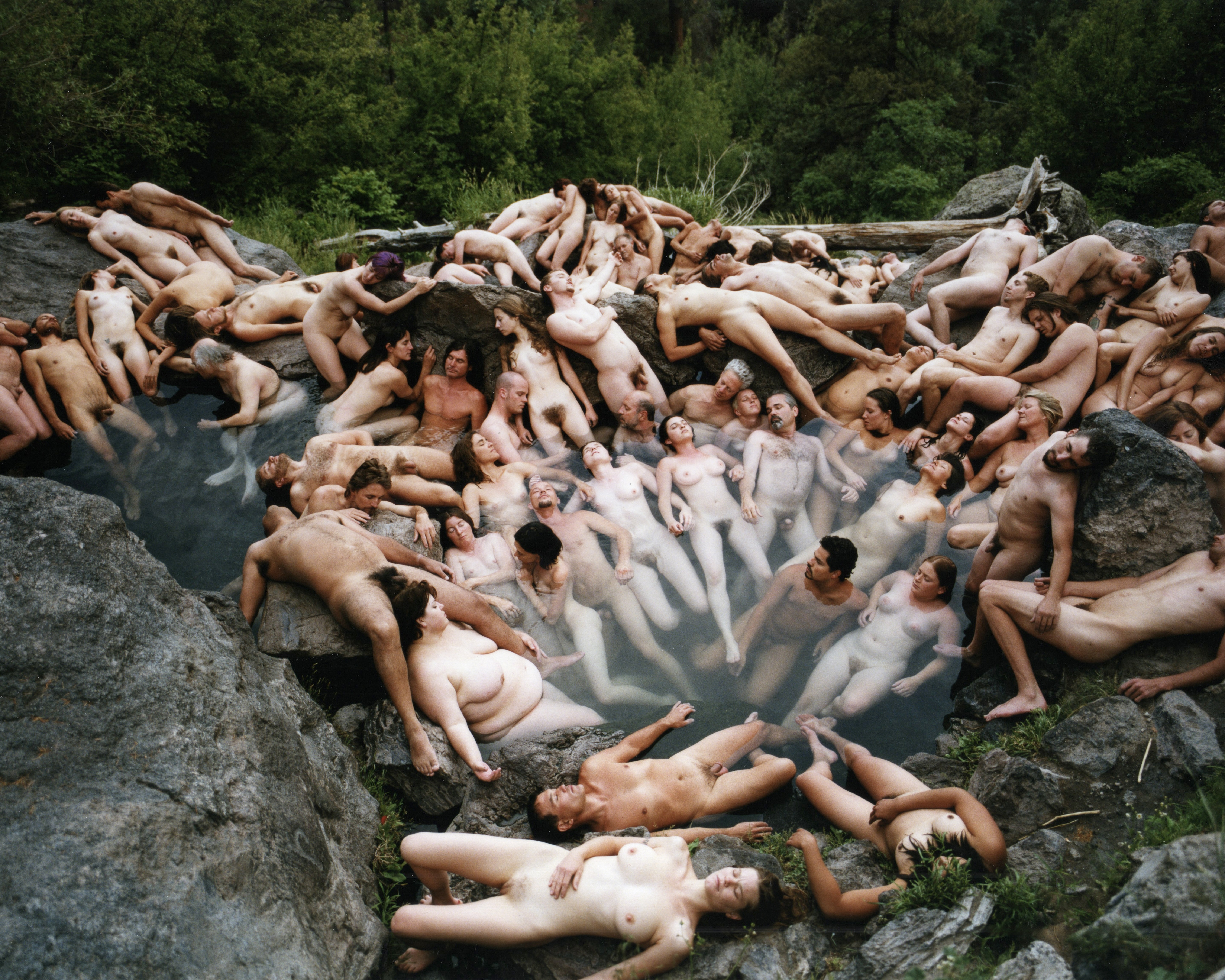
Spencer Tunick, New Mexico, USA, 2001, Pigment print, 121.92 x 152.4 cm, Edition of 6
You have photographed in many iconic locations. What’s left for you now?
Organizing these installations is always an immense amount of work. The producers who organize them are the real heroes, they are the true catalysts for making it all happen. But of course, you always reminisce about the early days. I miss making work on the streets of New York, and I hope to do more projects there somehow. New York is just amazing. At the same time, if I could photograph 5,000 people on that golf course right under Mount Fuji, that would be just as fulfilling. I think it’s entirely possible, too, because people would be barefoot, not wearing spikes.
After more than 20 years, what has changed in how people respond to your work?
I think now that I have this substantial body of work and it’s categorized on my website or arranged in an exhibition, it just feels really good. It feels like it’s all making sense now because I’ve made enough work where I’m able to separate it into different pockets, and that’s really important to me. I’m just very happy right now, and so lucky. It’s just insane to think that over 200,000 people have participated in total. Knowing there are 200,000 prints out there that people actually hang in their homes, that is a gift. It’s a complete gift.
You can now register to participate in Gran Spectrum’s registration online. Participants will receive details on access, timing, location and participation guidelines ahead of the installation.
Text: Victor Moreno