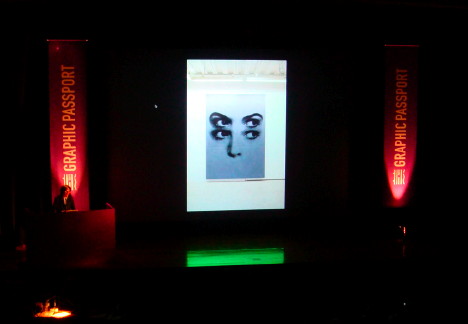

Hosted by +81Creatives – an editorial team for one of the Japanese creative magazines known as +81 – their first creative event TOKYO GRAPHIC PASSPORT took place over two days from October 11-12, with an aim to offer a place as a communication center for creative minds of the future. For their two main events entitled Tokyo Visualist Symposium and International Magazine Conference, leading creators and art directors of creative magazines were invited from Paris, Berlin, New York, Singapore, Amsterdam, London and Tokyo to fully deliver their creative senses through the conference.
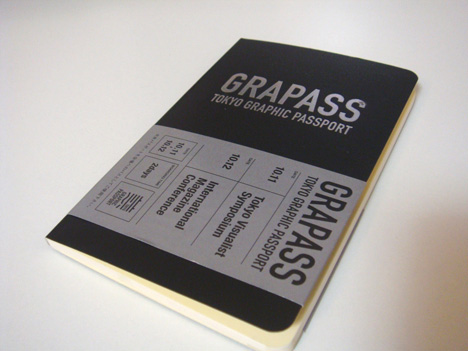
At the entrance of the event, the ticket was exchanged for a small notebook GRAPASS, which was actually used as a “passport” to get into the conference room.
For the first day of TOKYO GRAPHIC PASSPORT, the Tokyo Visualist Symposium was held introducing presentations by 6 different visual artists from Japan including Kohei Nawa (artist), Mika Ninagawa (photographer) x Shigeo Goto (editor), Tomoko Konoike (artist), Shun Kawakami (art director/designer), Taisuke Koyama (photographer), Hideki Inaba (graphic designer) x Satoru Yamashita (+81 editor-in-chief), who all main guest speakers were once featured on the innovative art book Tokyo Visualist.
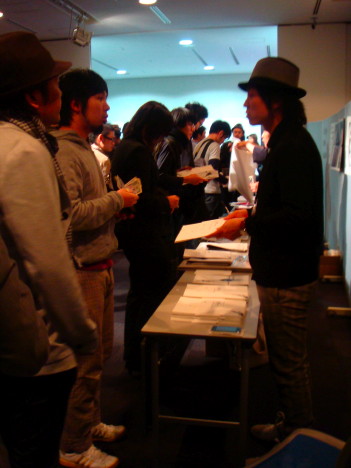
At the venue in Harajuku, the audience was given the opportunity to have face-to-face communication with some of the guest speakers who were selling their products by themselves at the display counter.
Here introduces the second part of the presentation at Tokyo Visualist Symposium.

Shun Kawakami gave the first presentation of the last half of Tokyo Visualist Symposium.
Started his activity as "artless" in 2000, kawakami has been working on various projects including his own creations; holding exhibitions and clients works. Besides his presentation about mainly his artworks and exhibitions, he presented about a recent exhibition collaborated with Takashi Kawada which was held in this fall at JAGDA TOKYO.
I liked the part when he said that artworks are created by meeting with people and we consequently meet those people who we should meet. He also presented us his working process on the graphic collage works and its concept, which would be a remarkable story for all designers.

The next presentation was by Taisuke Koyama, who is one of the most talented emerging young photographer in Japan. He bought a digital single-lens camera and that became his reason for starting his career as a photographer. In spite of studying photography at school, he studied on his own and continued his photographical creation to date. Showing us his various photos, he revealed the process of his photo shooting including maps where he went to take photos, details how he shoots at where. He also talked about some of rules for his work that he always go shooting around noon in sunny days and he never crop them. Expect to see his upcoming creation.

The Tokyo Visualist Symposium finished up with a presentation by Hideki Inaba, who came along with Satoru Yamashita, a creative director for +81. Inaba is one of the most remarkable designers, who has received high acclaim in Japan and abroad for his past works such as his design for +81 since the late 90's and SAL magazine, and that he has been selected for the cover design for the popular book "Graphic Design Now" by TASCHEN.
He talked about how he started his career as a designer. He mentioned that there wouldn't be his design without computers. It was interesting to know his concern for "micro" explored from the past to present works. He also revealed that he is interested in graphic, but he feels design is as important as graphics. Recently his activity includes one of the judging members for TDC and preparing for his exhibition in the next year.

For the second day, the International Magazine Conference was held for offering a conference inviting seven groups of art directors and editors from the creative magazines around the world, where you can experience “pondering the creativity of magazines”. Held in a historical building in Kudan Tokyo, the conference was kicked off, providing with another GRAPASS and "Tokyo Graphic Passport", the latest issue of "+81 Voyage".

Having worked as an art director for Purple Fashion for 13 years from 1993 to 2006, Christophe Brunnquell is currently working as an artist. He presented how tough the working process for Purple Fashion was that he could work on only 2 pages a day. What he concerned more than contents was its structure. He revealed that he has made the magazine breaking conventiona rules and having a playful mind. He ended with a recommendation for us to make a couture-made (not ready-made) magazine for young generation.

The Berlin-born creative culture magazine "032c". The name of the magazine is originated with the Pantone color number. Approaching new creative things constantly, the publisher and editor-in-chief Joerg Koch mentioned that the magazine questions us, and he explored the result in his magazine. He didn't accept defining the way to define things conventional way. As a result he listened and responded to the readers seriously, he was able to attract a great variety of readers. It was worth to listen to his presentation revealed the details about the design and background of the magazine.

Studio Newwork is a graphic design studio which consists of 4 designers who met together at Fashion Institute Technology in New York. They presented their experimental media "Newwork magazine" which was launched in 2007, defining the importance of design on Newwork magazine, and introducing the work in dividing 3 categories of 'contrast', 'rhythm' and 'study'. Every work was created under the concept and theme, and I felt Studio Newwork's deep interest in design.

Jop van Bennekom and Gert Jonkers together founded BUTT magazine in 2001 which focused on homosexual culture, and a men's style magazine FANTASTIC MAN in 2005.

The title "FANTASTIC MAN" is derived from wanting to choose words which they wouldn't say face to face. For this magazine, professional models rarely appear: they use people who have other works in their profession. There is no definition for choosing models. One of the big characteristics of FANTASTIC MAN is its centered layout. They think of images and typography separately and leave enough room to be innovative how they could enhance those aspects. They also presented FANTASTIC MAN in detail dividing 3 categories of NAMES, STYLE and TEXT, which was very interesting. The magazine is published twice a year. Check out it on the website.

Intersection is co-founded by Dan Ross, Rankin and a French art director and designer Yorgo Tloupas who has moved his base to London since 2001. He started to talk about his work at CLASH, which was his first magazine job as he was 21. He didn't get paid, but got freedom in turn. After CLASH, he worked on a free magazine called "magazine", which he changed the typeface for each issue while using the same grid for the cover design.

For Intersection readers, the magazine approaches a different way from the average style magazine. The readers may not know who Mark Jacobs is, but they are interested in his style and design. So Tloupas intended to showcase details by using graphical elements with a different way.
At the end of his presentation, he showed us a interesting film. Every time, he intends to take a kind of sense of humor and to do something different from others, but most of those approaches are illegal. The idea behind it is you are not the one who operates the bicycle, but the radio control car does.

Hideki Nakajima is one of the most remarkable graphic designers, who has collaborated with Ryuichi Sakamoto and who gained numerous awards including New York ADC gold award 5 times and the silver 7 times.
The magazine is now in the middle of depression. Nakajima first talked about the current magazine context in Tokyo. In his discussion about the self-published work collective book Revival, he said something interesting that "understandable design is forgettable and design should not be understandable".

His new book "LUMEN#05 Street view / Line" has been released recently. Even though he is represented by G/P Gallery, he mentioned about himself that he doesn't think himself as an artist and graphic designers can do whatever they want.
Works for LUMEN were created originally from his idea what graphic designers will do in the town after they hear the conversation between Daido Moriyama and I saying it would come end if a photographer quit shooting street snaps.

The last presenter of TOKYO GRAPHIC PASSPORT was Theseus Chan, a creative director of WERK. After establishing his office WORK in 1997, he founded WERK in 2000. Since then, he manages the only Comme des Garçon Guerrilla Store in South East Asia, at the same time publishes a visual book "Guerrillazine".

For Chan, saying "WERK directly reflects my inspiration, thought and ideas", it seems it's very important to have honest and pure mind for creating works. One of the feature about Singapore is that people sometimes regards weakness and mistakes as inability. As repulsive to such way of thinking, he became aware that there was beauty in the imperfection. He presented how WERK was created and how he chose ragged materials for the magazine, which he likes to use camomile paper for expressing anti-design. He is humble person, and the presentation was very interesting one.
At the 2-day conference event, it was worthwhile to hear from not only Tokyo-based speakers but also various magazine creators. Thanks to +81! It became a valuable experience to share each idea and thought on magazines.
The conference was held working with the latest issue "+81 Voyage", which you can explore and understand more. Hope to meet at the next conference soon!
TOKYO GRAPHIC PASSPORT
Date: October 11th-12th, 2009
Place: BELLSALE Harajuku, Kudan Kaikan
Host: +81Creatives
http://www.grapass.net
Text: Kayo Tamura
Translation: Mariko Takei