The third edition of the annual Art Dubai festival opened its doors at the popular Arabic-style entertainment complex Madinat Jumeirah.
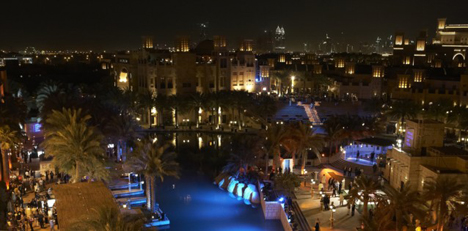
Art Dubai, evening, Courtesy of Art Dubai 2009
The art installations gathered for this world-class art event were as many as 2000, by 400 artists, from 68 galleries all around the world. The event was so large, that art displays spilled out of the large Madinat amphitheatre and flowed onto a neighbouring beach and parking area.
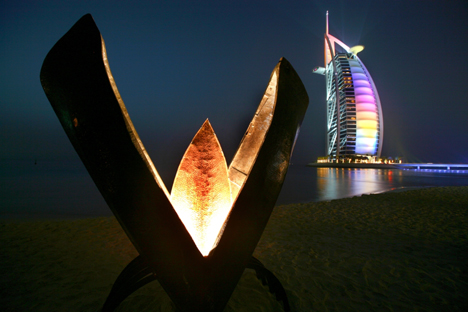
Beach Installation, Courtesy of Art Dubai 2009
The sponsors of the art fair, Abraaj Capital, gave prizes to three pairs of curators and artists. There prize given to these three art works were 20 million yen each. This prize can be the world most generous, given that the well-known Turner prize in the UK is six million yen. Despite the depression of the world economic crisis all over the world, the amount of capital behind the awards is surprising. Some artists have questioned the ethics of giving such a large amount of money. One prize winning artist told the Abu Dhabi-based newspaper The National: “I was talking to a painter friend of mine recently, whose prices recently went up beyond his imagination. Now he says that he cannot make a single stroke of the brush without thinking about money and that it is having a negative effect on him.” This prize was created to support emerging artists from the Middle East, North Africa and South Asia region. One of the award winning pieces is “Walk the Sky, Pisces” by Russian Algerian artist Zoulikha Bouabdellah and American curator Carole Solomon.
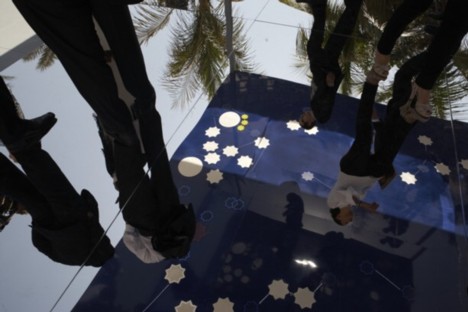
Zoulikha Bouabdellah, Walk on the Sky. Pisces. Courtesy of Art Dubai 2009
You can freely walk on their art piece. Stepping on the mirror board on the floor with reflection of constellation lights makes you feel like walking on a sheet of glass high up in the night sky.
Two polygonal stars also designed in this project are symbolic of God’s creation in long back in Arabic history. “Who never wanted to walk on the sky?” Bouabdellah laughs in an interview with The National. This project was inspired by a common dream of flying, as well as the artist’s roots in Arabic culture. Bouabdellah also said that the polygonal shapes represent civilisation as a melting pot of many different things.
As an opening event of Art Dubai, a workshop called START invited students from local schools to film making class, a debate on art and a free drawing project on a massive canvas.
However, Dubai still has a long way to go before an underground arts and culture movement begins to take shape. Projects like START stimulate the creativity of local students and help to bring future artists. ‘START uses art to enrich education for children in the Middle East.’ said Sonia Brewin, Director of START. ‘START and Barclays Wealth are making Art Dubai more accessible to new audiences, particularly Emirati families and young people with special needs,’ she added.

START at Barclays Wealth Learning Zone, School Tour, Courtesy of Art Dubai 2009
The above picture is a local girl’s school group visit to START. A large blackboard was set up in this workshop to be transformed into a work of art by students. From appearances, the students were quiet and serious while working on the project. In their each individual way, they were devoted to learning how to perfect their art.

© Mark Niedermann, Courtesy of Art Dubai 2009
Among 400 artists, there were many emerging artists, especially from Korea and China, with eye-catching pieces in this year’s Art Dubai. ‘The Car’ by Chinese artist Ma Jun is a car covered with vivid Oriental painting.

Zaha Hadid BENCH, , Courtesy of Max Protetch Gallery
In the Max Protetch gallery from New York, you would be astonished to see a very striking installation called ‘Bench’ by Zaha Hadid. Among other projects, the world famous Iraqi artist has designed Abu Dhabi’s Saadiyat Island Opera house to be completed in 2012.

Youssef Nabil, Self-Portrait with Laila Elwy, Cairo 2002
Dubai’s local gallery, ‘The third line’ is famous for wide collection of local artists from the region. As a popular haunt for local art fans, this gallery welcomed many visitors with original and creative pieces. Youssef Nabil’s ‘Self-portrait with Laila Elwy’ has sparkling element.

Arwa Abouon, Weapons of Mass Discussion, 2008
Another piece made us smile was ‘Weapons of Mass Discussion’ by Arwa Abouon. This humorous piece presents two chatty (could be aggressive) looking women as ‘weapons’, getting ready for discussion.

Sissi Farassat, Mosque, 2006
Next one, from Galerie Kashya Hildebrand, Zurich, is a cute piece called ‘Mosque’.
In the Middle East, most countries including the UAE are Muslim states. There is a very strict censorship even on art works in case of nudity or insult for Islam.
This largest Middle Eastern art fair is not an exception. There was some controversy over one installation, which depicted a page from Holy Koran with weaponry and horses. The management of gallery decided to take this piece off from exhibition in the middle of the fair, local media reported.
Another one was the art piece by Lebanese Australian artist George Phillip titled ‘Insh’Allah Surfboard’. The word ‘Insh’Allah’ (meaning ‘As God wills’ in Arabic) is often considered a holy word, but in this case was painted on the surfboard. This was regarded as controversial, because surfboards are to be stamped on. But Phillip cleared his point that the surfboards are not for actual use, so it will neither be placed on the ground nor stamped on. His piece attracted many visitors after.

BREENSPACE, Sydney, Courtesy of Art Dubai 2009
Dubai as a trading hub is showing a rapid growth. In this business-oriented city, there are many different kind of exhibitions all through the year. For those in art industry, this art fair is also a big business opportunity. Last year’s Art Dubai made record sales in the auction stage. The price of this year’s art pieces varied from 50 thousand yen to one billion yen. But the economic crisis was bound to have some effect on Dubai’s art business. Some local artists had to bear the devaluation of their artworks as low as one tenth of the value in Dubai’s boom time, according to Time Out Dubai. One of the exhibitors of Art Dubai 2009, L&M Arts told local newspaper Khaleej Times:“We are doing as well as we thought we would only because our expectations for this year are not as high. The global economy is down and so is the stock market but people are still buying art pieces.” Michael Schultz Gallery with Ma Jun’s ‘Car’ sold their art pieces for 9.5 million yen, 6.3 million yen, three million yen. There were also some galleries which sold out all their pieces at the fair.
Art Dubai’s co-founder and director, John Martin said: “Dubai is turning into a meeting point for artists.” He said that what makes Dubai a fast-rising cultural hub is its receptive attitude towards new ideas.
There is a rumour that Dubai is directly hit by the crisis and the bubble has burst. This massive art event showed that there is still lot of vitality in this city. Art Dubai 2009 closed its curtain with loud applause from visitors came from all over the world. It is interesting to see how Art Dubai develops in years to come, but also you might as well explore your hidden potential to win Abraaj Capital Art Prize for a year from now.
Art Dubai 2009
Date: March 18th - 21st, 2009
Place: Madinat Jumeirah
Text: Mamiko Kawakami